· Umm Aishah · 7 min read
Zakat al-Fitr Explained for Families and Kids: What, When and How Much
A clear family guide to Zakat al-Fitr: who pays it, how much a sa' is, why it is given as food, when it must be given, and simple ways to involve your children.
On the last day of Ramadan our kitchen floor usually has bags of rice lined up by the door, one for each member of the family, the baby included. My daughters love counting them. It has become one of their favourite parts of the end of Ramadan, and it is a lesson that sticks far better than anything I could explain from a book.
Zakat al-Fitr is short, simple and easy to forget in the Eid rush. Here is what it is, according to the authentic Sunnah, and how to make it a family act of worship.
What is Zakat al-Fitr?
Zakat al-Fitr is a small, obligatory charity given at the end of Ramadan. ‘Abdullah ibn ‘Umar (may Allah be pleased with him) said:
فَرَضَ رَسُولُ اللَّهِ صلى الله عليه وسلم زَكَاةَ الْفِطْرِ صَاعًا مِنْ تَمْرٍ، أَوْ صَاعًا مِنْ شَعِيرٍ عَلَى الْعَبْدِ وَالْحُرِّ، وَالذَّكَرِ وَالأُنْثَى، وَالصَّغِيرِ وَالْكَبِيرِ مِنَ الْمُسْلِمِينَ، وَأَمَرَ بِهَا أَنْ تُؤَدَّى قَبْلَ خُرُوجِ النَّاسِ إِلَى الصَّلاَةِ
“Allah’s Messenger (ﷺ) enjoined the payment of one Sa’ of dates or one Sa’ of barley as Zakat-ul-Fitr on every Muslim slave or free, male or female, young or old, and he ordered that it be paid before the people went out to offer the ‘Id prayer.” (al-Bukhari 1503; see also Muslim 984a)
Why do we give it?
Ibn ‘Abbas (may Allah be pleased with him) said:
فَرَضَ رَسُولُ اللَّهِ صلى الله عليه وسلم زَكَاةَ الْفِطْرِ طُهْرَةً لِلصَّائِمِ مِنَ اللَّغْوِ وَالرَّفَثِ وَطُعْمَةً لِلْمَسَاكِينِ مَنْ أَدَّاهَا قَبْلَ الصَّلاَةِ فَهِيَ زَكَاةٌ مَقْبُولَةٌ وَمَنْ أَدَّاهَا بَعْدَ الصَّلاَةِ فَهِيَ صَدَقَةٌ مِنَ الصَّدَقَاتِ
“The Messenger of Allah (ﷺ) prescribed the sadaqah (alms) relating to the breaking of the fast as a purification of the fasting from empty and obscene talk and as food for the poor. If anyone pays it before the prayer (of ‘Id), it will be accepted as zakat. If anyone pays it after the prayer, that will be a sadaqah like other sadaqahs (alms).” (Abu Dawud 1609, graded hasan by al-Albani)
So it has two purposes, and both are easy for children to understand:
- It cleans our fast from the slips of the tongue we made during Ramadan.
- It feeds the poor so that they can also enjoy Eid.
Who must pay it?
It is due for every Muslim: male and female, young and old (al-Bukhari 1503). That includes children and babies. The head of the household pays it on behalf of those he provides for. ‘Abdullah ibn ‘Umar “used to give Sadaqat-ul-Fitr for every young and old person”, as his student Nafi’ reported (al-Bukhari 1511).
So a family of six gives six portions.
What do we give? Food, not cash
The Prophet (ﷺ) set it as a measure of food. Abu Sa’id al-Khudri (may Allah be pleased with him) said:
كُنَّا نُخْرِجُ زَكَاةَ الْفِطْرِ صَاعًا مِنْ طَعَامٍ، أَوْ صَاعًا مِنْ شَعِيرٍ، أَوْ صَاعًا مِنْ تَمْرٍ، أَوْ صَاعًا مِنْ أَقِطٍ، أَوْ صَاعًا مِنْ زَبِيبٍ
“We used to give one Sa’ of meal or one Sa’ of barley or one Sa’ of dates, or one Sa’ of cottage cheese or one Sa’ of Raisins (dried grapes) as Zakat-ul-Fitr.” (al-Bukhari 1506)
These were the staple foods of Madinah at the time. The scholars explain that today we give from the staple food of our own country, such as rice, wheat, flour or dates.
Is cash allowed? The scholars have differed on this, but the position of the majority, and the position of the major Salafi scholars, is that it must be given as food, because that is what the Prophet (ﷺ) prescribed and what the Companions did.
- Shaykh ‘Abd al-‘Aziz ibn Baz said it is not permissible to give it as money according to the majority of the scholars, and that it is obligatory to give it as food, one sa’ of the staple food of the land, for male and female, young and old (binbaz.org.sa).
- Shaykh Muhammad ibn Salih al-‘Uthaymeen said that dirhams (money) do not suffice for it and that it must be food, citing the hadith of Abu Sa’id and the hadith of Ibn ‘Umar (binothaimeen.net).
If you use a charity or your local masjid to distribute it, ask them to buy and hand over food on your behalf, rather than passing on cash.
How much is a sa’?
A sa’ is a measure of volume, not weight. Shaykh Ibn Baz described it as four full double handfuls of a man of average hands, and it is commonly estimated at about 3 kg of staple food per person. Since grains differ in weight, many families round up to be safe. Giving a little more is good; giving less is not.
Example: a family of five gives roughly 15 kg of rice, or the equivalent in another staple food.
When do we give it?
- The best time is on the morning of Eid, before the Eid prayer. The Prophet (ﷺ) “ordered the people to pay Zakat-ul-Fitr before going to the ‘Id prayer” (al-Bukhari 1509).
- It is allowed a day or two before Eid. Nafi’ reported that “People used to give Sadaqat-ul-Fitr (even) a day or two before the ‘Id” (al-Bukhari 1511). This is very helpful if the food needs to reach a family in time.
- After the Eid prayer it no longer counts as Zakat al-Fitr; it becomes ordinary charity (Abu Dawud 1609). So do not leave it too late.
For Ramadan 2027, Eid al-Fitr is expected around 9 or 10 March 2027, depending on the moon. Put a reminder in your planner for the last two days of the month.
How to involve children
Zakat al-Fitr is one of the easiest acts of worship to share with children, because they can see it, carry it and count it.
1. Count heads together. Ask your children to list everyone in the family, including the baby. Each name is one sa’.
2. Measure it out. Use kitchen scales or a measuring jug to divide the rice into bags, one per person. Younger children can scoop; older ones can weigh and record.
3. Label the bags. Write each family member’s name on a bag. Children love seeing “their” bag.
4. Talk about why. Explain the two purposes: it cleans our fast, and it gives a poor family food for Eid. Ask: “What would Eid feel like if we had nothing to eat?”
5. Deliver it if you can. If it is safe and appropriate, let older children come with you to hand it to the masjid or a family in need. Teach them to give quietly and kindly, without making the person feel small.
6. Make a dua. There is no special dua fixed for giving Zakat al-Fitr, so keep it simple: ask Allah to accept it from you, in your own words.
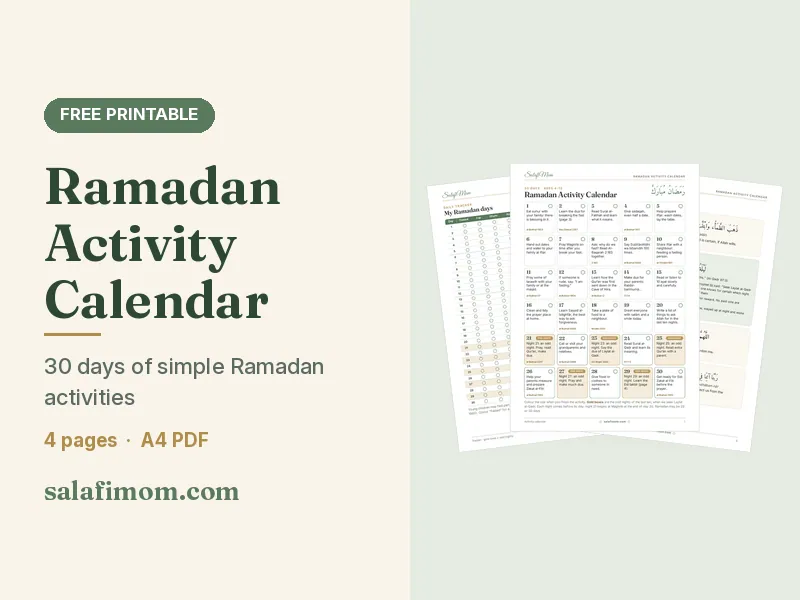
Our Good Deeds Tracker has space to record it, and the Ramadan Activity Calendar is a good place to mark the day you will give it. For teaching children about charity more broadly, see teaching kids about zakat.
Quick family checklist
- Count everyone in the household, including babies
- Choose a staple food (rice, flour, dates)
- Measure about 3 kg per person
- Decide who will receive it, or which masjid will distribute food
- Give it a day or two before Eid, or on Eid morning before the prayer
- Involve the children in measuring, labelling and giving
Related reading
Plan the whole month with our Sunnah-based Ramadan planner for mums, keep the final nights strong with the last ten nights of Ramadan with children, and get ready for the day itself with Eid activities for kids the sunnah way.
May Allah accept our fasting, purify it, and accept our Zakat al-Fitr from us and our families. Ameen.