· Umm Aishah · 9 min read
The Authentic Dua for Breaking the Fast: A Kids' Guide (With Meaning)
The iftar dua the Prophet (ﷺ) said, in Arabic with transliteration and a child-friendly meaning, when to say it, and how we teach it to little ones at the iftar table.
The authentic dua for breaking the fast is short enough for a five-year-old to learn in a week:
ذَهَبَ الظَّمَأُ، وَابْتَلَّتِ الْعُرُوقُ، وَثَبَتَ الْأَجْرُ إِنْ شَاءَ اللَّهُ
Dhahaba adh-dhama’u, wabtallatil-‘urūqu, wa thabatal-ajru in shā’ Allāh.
“The thirst has gone, the veins are moistened, and the reward is certain, if Allah wills.”
Ibn ‘Umar (may Allah be pleased with him) said that when the Messenger of Allah (ﷺ) broke his fast, he would say these words (Abu Dawud 2357, graded hasan by al-Albani). The child says Bismillah, eats a date or drinks some water, and then says the dua. That is the whole of it.
In our home this is the first Ramadan dua each of my daughters learned, before they could fast a single morning. Below is how we teach it, word by word, with the little sunnahs that go with it, and the one popular wording I gently ask you to leave out.
The iftar dua, line by line for children
Children remember a dua far better when they understand it. Ours is made of three short sentences, and each one describes something a child can actually feel at the iftar table.
| Arabic | Say it | What it means |
|---|---|---|
| ذَهَبَ الظَّمَأُ | Dhahaba adh-dhama’u | The thirst has gone |
| وَابْتَلَّتِ الْعُرُوقُ | wabtallatil-‘urūqu | and the veins are wet again |
| وَثَبَتَ الْأَجْرُ إِنْ شَاءَ اللَّهُ | wa thabatal-ajru in shā’ Allāh | and the reward is certain, if Allah wills |
I explain it to my younger ones like this: “All day your mouth was dry. Now you drank water and the thirst has gone. Your body feels wet and fresh inside. And the reward for your fast is written for you, if Allah wills.” The last line is the one they love most, because it tells them their effort was not wasted.
The “in shā’ Allāh” at the end is part of the dua. It teaches children that we hope for the reward from Allah, and that only He accepts deeds.
When do we say it: before or after eating?
After the first sip or date. The dua says the thirst has gone, so it only makes sense once the child has drunk or eaten something. The order at our table is:
- Wait for Maghrib. As soon as the time comes, we break the fast without delay. The Prophet (ﷺ) said: “The people will remain on the right path as long as they hasten the breaking of the fast” (al-Bukhari 1957).
- Say Bismillah. As before any meal: بِسْمِ اللَّهِ. The Prophet (ﷺ) taught a young boy at his table, “O boy! Mention the Name of Allah and eat with your right hand, and eat of the dish what is nearer to you” (al-Bukhari 5376).
- Eat a date, or drink water. Anas (may Allah be pleased with him) said the Prophet (ﷺ) broke his fast before praying with fresh dates; if there were none, with dry dates; and if there were none, he took a few sips of water (Abu Dawud 2356, graded hasan sahih by al-Albani).
- Say the dua: Dhahaba adh-dhama’u, wabtallatil-‘urūqu, wa thabatal-ajru in shā’ Allāh.
Make your own duas before Maghrib
The minutes before iftar are a precious time to ask Allah for anything. Shaykh Muhammad ibn Salih al-‘Uthaymeen (may Allah have mercy on him) said that dua should be made before breaking the fast, at Maghrib, because the fasting person is then at his most humble and weak, and after eating a person relaxes and may become heedless (al-Liqa’ al-Shahri 8, quoted at islamqa.info/en/answers/14103).
So at our house the last ten minutes before the adhan are “dua time”. Everyone sits at the table with their hands raised, and the children ask Allah for whatever they want, in their own words. My youngest once asked for “a kitten and Jannah”, in that order. That is fine. She is learning that Allah is near. Allah says, right among the verses about fasting:
وَإِذَا سَأَلَكَ عِبَادِى عَنِّى فَإِنِّى قَرِيبٌ ۖ أُجِيبُ دَعْوَةَ ٱلدَّاعِ إِذَا دَعَانِ
“And when My servants ask you concerning Me, indeed I am near. I respond to the invocation of the supplicant when he calls upon Me.” (al-Baqarah 2:186)
What about “Allahumma laka sumtu”?
Many of us grew up with “Allahumma laka sumtu wa ‘ala rizqika aftartu” as the iftar dua, and you will find it on most kids’ Ramadan printables. The narration it comes from (Abu Dawud 2358) is mursal, with a break in its chain, and al-Albani graded it da’if (weak). Islam Q&A explains this in its answer on the dua for breaking the fast (islamqa.info/en/answers/26879).
So we do not teach it to our children as the Prophet’s dua. We teach Dhahaba adh-dhama’u instead, which is hasan. If your child already knows the other wording, there is no need to make them feel they did something wrong. Simply say, “We found the dua the Prophet (ﷺ) said, so let’s learn that one together now.”
How to teach the iftar dua by age
Ages 2 to 4: hear it every evening
Little ones learn by hearing. Say the dua out loud, slowly, every single iftar, even if they are not fasting at all. Let them hold the plate of dates and pass one to each person. Within a couple of weeks you will hear “dhahaba…” coming from the high chair.
- Say just the first line for the first week.
- Add a little action: a hand on the throat for “thirst”, wiggling fingers for “veins”, a hand on the heart for “reward”.
- Praise them every time they join in.
Ages 5 to 7: learn it in three steps
- Week one: Dhahaba adh-dhama’u.
- Week two: add wabtallatil-‘urūqu.
- Week three: add wa thabatal-ajru in shā’ Allāh.
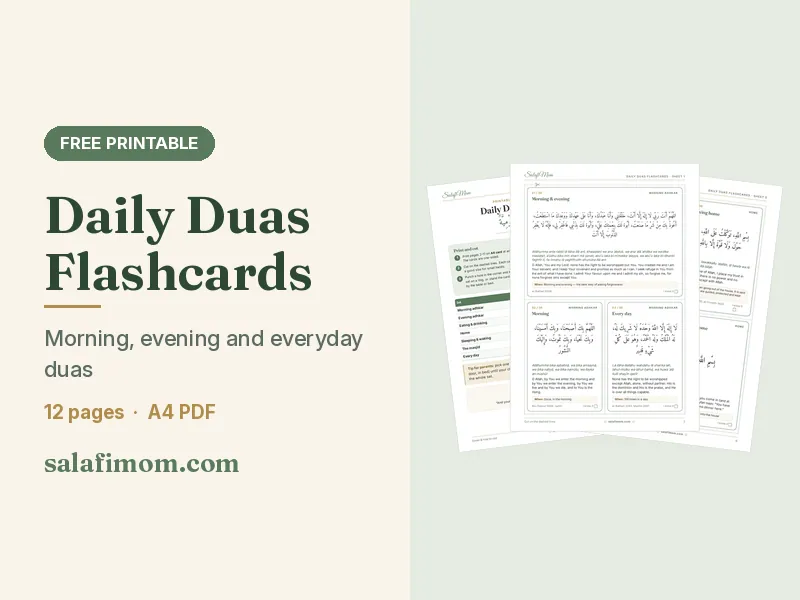
Put the dua card by the date bowl. Our Daily Duas Flashcards are fully voweled and referenced, so a child who is starting to read Arabic can follow along. If your child does a “half-day” fast, let them say the dua when they break it too. It is good practice, and it connects the words to the feeling.
Ages 8 and up: understand and lead
- Ask them to explain the meaning to a younger sibling.
- Let them lead the dua at the table, out loud, for the whole family.
- Teach them why we say it after eating, and why we prefer authentic wording. Children this age love knowing that we check our sources.
When someone gives you iftar
Ramadan is full of invitations, and children love going to other people’s homes for iftar. Two things are worth teaching here.
Feeding a fasting person carries a great reward. The Prophet (ﷺ) said: “Whoever provides the food for a fasting person to break his fast with, then for him is the same reward as his, without anything being diminished from the reward of the fasting person” (at-Tirmidhi 807, graded sahih by al-Albani). Let your children carry a plate of dates to a neighbour, or hand out water at the masjid. They are sharing in a big reward.
Make dua for the people who fed you. When the Prophet (ﷺ) ate at the home of Sa’d ibn ‘Ubadah, he said:
أَفْطَرَ عِنْدَكُمُ الصَّائِمُونَ، وَأَكَلَ طَعَامَكُمُ الْأَبْرَارُ، وَصَلَّتْ عَلَيْكُمُ الْمَلَائِكَةُ
Aftara ‘indakumuṣ-ṣā’imūn, wa akala ṭa’āmakumul-abrār, wa ṣallat ‘alaykumul-malā’ikah.
“May the fasting break their fast with you, may the righteous eat your food, and may the angels pray for blessing upon you.” (Abu Dawud 3854, graded sahih by al-Albani)
This one is longer, so it suits children of eight and over. For younger ones, the shorter host dua from Sahih Muslim works beautifully: اللَّهُمَّ بَارِكْ لَهُمْ فِيمَا رَزَقْتَهُمْ، وَاغْفِرْ لَهُمْ وَارْحَمْهُمْ, “O Allah, bless them in what You have provided for them, and forgive them and have mercy on them” (Muslim 2042).
Little iftar habits that build a lifetime
- Dates on the table before Maghrib. A child can be in charge of this every day.
- Water in small cups. Big glasses lead to big spills and big tummy aches.
- No screens near iftar. The last minutes are for dua, not for scrolling. Children notice what we do with those minutes.
- Pray Maghrib together after the dates and water, then come back for the main meal. This follows the order in the hadith of Anas, who described the Prophet (ﷺ) breaking his fast “before praying”.
- Keep it calm. If your child spills the water or forgets the dua, smile. We are building love for this moment.
A quick note on health: if your child is fasting for longer stretches, check with your doctor about any medical condition, and stop the fast if they become dizzy or unwell. Our guide on teaching children to fast gradually has an age-by-age plan.
Frequently asked questions
What is the dua for breaking the fast for kids?
The authentic iftar dua is Dhahaba adh-dhama’u, wabtallatil-‘urūqu, wa thabatal-ajru in shā’ Allāh, meaning “The thirst has gone, the veins are moistened, and the reward is certain, if Allah wills” (Abu Dawud 2357, hasan). Children say Bismillah, eat a date or drink water, then say it.
Should a child who is not fasting say the iftar dua?
The dua describes breaking a fast, so it belongs to the one who fasted. Little children who are not fasting can still listen and repeat it with the family as practice, so that they know it well when their own fasting begins.
Is “Allahumma laka sumtu” wrong to say?
The narration is weak (Abu Dawud 2358, graded da’if by al-Albani), so it should not be taught as the Prophet’s dua. We teach the hasan wording instead.
Can my child make dua in English at iftar?
Yes. Personal duas in the minutes before Maghrib can be in any language. Keep the Prophet’s own words, Dhahaba adh-dhama’u…, in Arabic.
Is there a printable iftar dua card?
The iftar dua is included in our free Daily Duas Flashcards. Keep it next to the dates so the whole family sees it at iftar.
Keep going this Ramadan
The iftar dua is one small piece of a child’s Ramadan. For the rest of the month, see our Ramadan activities for kids, and when the month draws to a close, our guide to the last ten nights of Ramadan with children has the Laylat al-Qadr dua to learn next. Ramadan 2027 is expected to begin around 8 February 2027, depending on the sighting of the moon, so there is plenty of time to practise at the dinner table now.
May Allah accept the fasts of our children and make their first duas the beginning of a lifetime of turning to Him. Ameen.