· Umm Aishah · 8 min read
Ramadan Activities for Toddlers and Preschoolers (Sunnah-Based, No Music)
Simple Ramadan activities for children aged 18 months to 5 years: iftar table jobs, date counting, a busy basket inspired by the Companions, sadaqah jars and calm Qur'an time. No music, no faces, no special supplies.
The best Ramadan activities for toddlers are not crafts at all. They are small jobs inside the real Ramadan of the family: putting dates on the iftar plate, dropping a coin in the sadaqah jar, sitting on a prayer mat next to Mama, and hearing the iftar dua every evening. A two-year-old does not understand fasting, but she understands “this is what our family does now”, and that is the foundation.
Below are the activities we use with our little ones, grouped by age, all of them simple, faceless and free of music. Most need nothing more than what is already in your kitchen. If you have older children too, our main guide to Ramadan activities for kids covers ages 5 to 12.
Ramadan 2027 is expected to begin around 8 February 2027, depending on the sighting of the moon, so this is a good time to plan.
Why toddlers belong in Ramadan
The Companions did not leave their young children out of Ramadan’s atmosphere. Al-Rubayyi’ bint Mu’awwidh (may Allah be pleased with her) described how they trained their children to fast the day of ‘Ashura: “We used to make toys of wool for the boys and if anyone of them cried for food, he was given those toys till it was the time of the breaking of the fast” (al-Bukhari 1960).
Toddlers are far too young to fast, but the lesson for us is clear: the Companions planned activities for their little ones around worship, so that the children were part of it and kept busy and content.
The Prophet (ﷺ) himself took small children seriously. Anas (may Allah be pleased with him) said: “The Prophet (ﷺ) used to mix with us to the extent that he would say to a younger brother of mine, ‘O Aba ‘Umair! What did the Nughair (a kind of bird) do?’” (al-Bukhari 6129). He spoke to a little boy about his pet bird. Our toddlers’ small worlds matter too.
Ages 18 months to 3: copy and help
At this age, children learn almost entirely by copying. Keep each activity to a few minutes and repeat it every day.
1. The iftar date job
Give your toddler one job every evening: carrying the dates to the table (in an unbreakable bowl). Each person gets one date in front of their place. Counting is optional; the routine is the point. When the adhan comes, they sit with everyone while you say Bismillah, eat a date, and then say the iftar dua out loud. Our post on the dua for breaking the fast for kids has the authentic wording.
Safety: always remove the stones from dates and cut them into small pieces for toddlers. Whole dates are a choking risk for under-fives. Ask your doctor if you are unsure what is safe for your child.
2. “Bismillah” at every snack
Ramadan is a lovely time to make Bismillah automatic. The Prophet (ﷺ) taught a young boy at his table: “O boy! Mention the Name of Allah and eat with your right hand, and eat of the dish what is nearer to you” (al-Bukhari 5376). Say it together at every snack and meal. Your toddler is not fasting, but they are learning the manners of eating that go with iftar.
3. A prayer mat of their own
Give your toddler a small prayer mat and let them stand beside you for Maghrib. They will wander off, sit down, climb on your back during sujood. That is normal. They are learning that prayer is part of the day. Do not scold; just keep praying.
4. The sadaqah jar
Put a clear jar on a low shelf. Each day your toddler drops in a coin you give them. At the end of the month, take them with you to give it. The Prophet (ﷺ) said: “Save yourself from Hell-fire even by giving half a date-fruit in charity” (al-Bukhari 1417). Even a coin carried by a small hand is real charity.
5. Listening to Qur’an
Play a short surah, recited without music or sound effects, during a quiet moment each day. Al-Fatihah and the last three surahs are perfect. Keep it short and calm, and turn it off when they lose interest so it never becomes background noise.
Ages 3 to 5: small tasks and big questions
Preschoolers can follow two-step instructions, love “real” jobs, and ask endless questions. This is the age to start explaining why.
6. The Companions’ busy basket
Inspired by the wool toys in al-Bukhari 1960, we fill a basket that only comes out in the late afternoon, the hardest time of a fasting day for the grown-ups. Ours has:
- a ball of wool and some wooden pegs
- a lacing card shaped like a masjid
- a small bag of dried lentils and a scoop
- play dough and cookie cutters (geometric shapes, stars and dates; no animals or faces)
- a few board books about Ramadan with no pictures of living beings
Bringing the basket out at the same time each day makes it special, and it gives you a calmer half hour before iftar.
7. Date counting and sorting
Put a pile of pitted dates (or date-shaped paper cut-outs) on a tray. Ask your child to count out one for each person in the family, then sort them into “big dates” and “small dates”. Older preschoolers can count to 30 and talk about the thirty days of Ramadan. It is maths, Ramadan and helping the family, all in one activity.
8. Rice bags for Zakat al-Fitr
At the end of Ramadan we give Zakat al-Fitr as food. Preschoolers love to help scoop rice into bags, one for each member of the family. Explain simply: “This is so that poor families have food on Eid too.” Our guide to Zakat al-Fitr for families explains the amounts and timing.
9. A sunset walk
On a calm day, take a short walk just before Maghrib and watch the sky change colour. Talk about how Allah made the sun, and how the fast ends when it sets. Keep it short if you are fasting, and go when it is cooler.
10. Colouring that fits the Sunnah
Preschoolers love colouring. We choose pages of masjids, dates, Arabic letters and geometric patterns, never animals or people. Our free mosque and geometric pattern colouring pages in the printables library are good for this age. Talk about the masjid while they colour: “Who goes to the masjid? What do we do there?“
11. One dua a week
Pick one short dua each week and say it together at the right moment: Bismillah before food, Alhamdulillah after, the dua for leaving the house. Our Daily Duas Flashcards are referenced and fully voweled; stick one on the fridge each week.
12. A “good deed” sticker each day
Use a very simple chart with one deed for the whole week, for example “I said salam” or “I shared”. At bedtime, add a plain sticker together and say “Allah saw that, alhamdulillah.” Our Ramadan good deeds chart post has a 30-day list you can simplify for little ones.
A simple daily rhythm for toddlers in Ramadan
You do not need a timetable. A loose rhythm is enough:
- Morning: breakfast with Bismillah, a short surah, normal play.
- Late morning: an outing or outdoor play, while your energy is higher.
- After Dhuhr: nap time for them, and a rest or Qur’an time for you.
- Late afternoon: the busy basket, colouring or dough.
- Before Maghrib: the date job, dua time at the table, then iftar.
- Evening: bath, bedtime duas, and sleep, so you can pray at night.
If a day falls apart, let it. Ramadan with toddlers is about small habits repeated over many days, not a perfect schedule.
What we leave out (and why)
Many toddler Ramadan ideas online include songs, cartoon characters and decorations. To stay on the safe side of the Sunnah, we leave these out:
- Music and nasheeds with instruments. Little ones can learn through the Qur’an, duas and your own voice.
- Cartoons and characters with faces, including Ramadan cartoons. Toddlers do not need screens to understand Ramadan.
- Drawing or crafting animals and people. We stick to masjids, dates, letters and patterns.
- Ramadan lanterns, crescent-moon decorations and countdown calendars. These are not from the practice of the Prophet (ﷺ) or the Companions, so we do not make them part of our children’s idea of Ramadan.
- Fasting for toddlers. Children this young should eat and drink normally. Fasting practice starts much later; see our guide to teaching children to fast gradually.
Frequently asked questions
What are good Ramadan activities for toddlers?
Real jobs in the family’s Ramadan: carrying dates to the iftar table, saying Bismillah, dropping coins in a sadaqah jar, standing on a prayer mat at Maghrib, and listening to a short surah. Add a busy basket, colouring and counting for preschoolers.
Should toddlers fast in Ramadan?
No. Fasting is not required until puberty, and toddlers need regular food and water. They can join the family at suhur or iftar for the atmosphere, but they should eat normally.
How do I keep my toddler busy while I am fasting?
Plan quiet activities for the late afternoon, like the Companions’ wool toys (al-Bukhari 1960): a basket of special toys, play dough, lacing, colouring and a short walk. Keep outings for the morning when you have more energy.
Are there Ramadan activities for toddlers without music?
Yes, all of the activities above. Use Qur’an recitation without music, simple duas and your own voice instead of songs.
Is there a free printable Ramadan activity pack for toddlers?
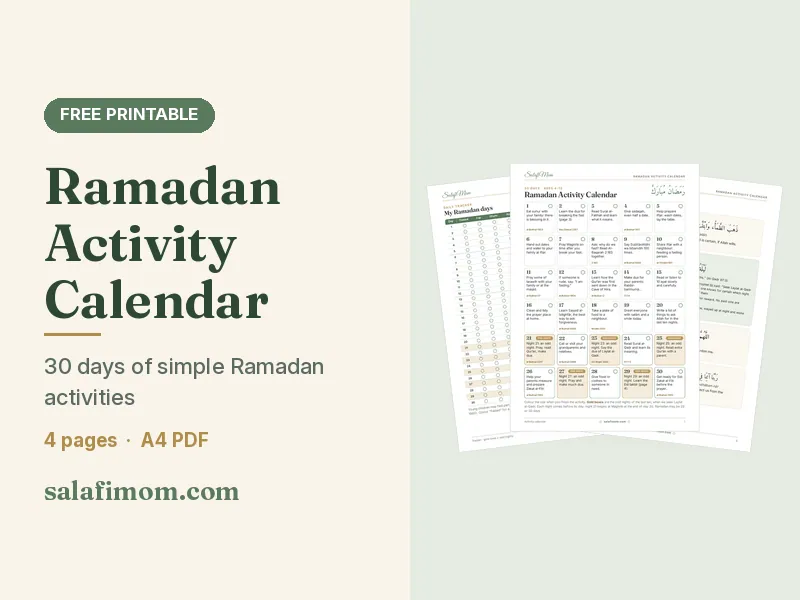
Start with our free Ramadan Activity Calendar, which gives one simple activity for each day of the month, and pick the easiest ones for your little one. A faceless toddler pack is something we are working on.
May Allah make our little ones grow up loving Ramadan, and make it easy for every mother fasting with a toddler on her hip. Ameen.