· Umm Aishah · 8 min read
Ramadan Good Deeds Chart for Kids: 30 Days of Sunnah Deeds (Free Printable)
A 30-day Ramadan good deeds list for children, every deed rooted in the Qur'an and authentic Sunnah, plus how to use a good deeds chart without turning worship into a prize race.
A Ramadan good deeds chart works best when it holds one small, real deed a day that a child can actually do, and when every deed on it comes from the Qur’an and the Sunnah. Below is the 30-day list we use at home, with the evidence for each one, and a free Good Deeds Tracker to print and stick on the fridge.
The rule in our house is simple: the chart is there to help children notice their good deeds, not to buy them. Allah sees every deed whether it is ticked or not:
فَمَن يَعْمَلْ مِثْقَالَ ذَرَّةٍ خَيْرًۭا يَرَهُۥ
“So whoever does an atom’s weight of good will see it.” (az-Zalzalah 99:7)
Ramadan 2027 is expected to start around 8 February 2027, subject to the sighting of the moon. Print the chart now, talk about it in Sha’ban, and your children will start the month already excited.
Why a good deeds chart helps children in Ramadan
My daughters are very different. One will do a kind thing and forget it immediately. The other will do the same kind thing and tell the whole street. A chart helps both of them. The first one sees how much good she does, and the second one learns that the good deed is between her and Allah, and the chart is only a reminder.
Three hadith shape how we use it:
- Small and steady wins. The Prophet (ﷺ) said: “The most beloved deed to Allah is the most regular and constant even if it were little” (al-Bukhari 6464). One deed a day for thirty days is better than ten deeds on the first day and none after.
- No good deed is too small. The Prophet (ﷺ) said: “Don’t consider anything insignificant out of good things even if it is that you meet your brother with a cheerful countenance” (Muslim 2626).
- The intention matters most. “The reward of deeds depends upon the intentions” (al-Bukhari 1). Before a child ticks a box, we ask: “Who did you do it for?” The answer we are aiming for is “For Allah.”
The 30-day Ramadan good deeds list
Each day has one deed. Older children can do more; little ones may need your help. Where a deed comes straight from a hadith, the reference is beside it.
Days 1 to 10: deeds at home
- Say Bismillah before every meal, and eat with your right hand. The Prophet (ﷺ) taught this to a young boy at his table (al-Bukhari 5376).
- Wake up for suhur (older children) or help set the suhur table (younger ones). “Take suhur, as there is a blessing in it” (al-Bukhari 1923).
- Put the dates on the iftar table before Maghrib, ready for the family.
- Smile at everyone in your family today. “Your smiling in the face of your brother is charity” (at-Tirmidhi 1956, graded sahih by al-Albani).
- Say only good words, or stay quiet. “Anybody who believes in Allah and the Last Day should talk what is good or keep quiet” (al-Bukhari 6018).
- Make your bed and tidy your room without being asked.
- Help in the kitchen before iftar: wash fruit, fill water cups, fold napkins.
- Say “Jazakallahu khayran” to someone who helps you. “May Allah reward you with good” is the fullest way to thank a person (at-Tirmidhi 2035, graded sahih by al-Albani).
- Make dua for your parents: رَبِّ ارْحَمْهُمَا كَمَا رَبَّيَانِي صَغِيرًا, Rabbir-ḥamhumā kamā rabbayānī ṣaghīrā, “My Lord, have mercy on them as they raised me when I was small” (al-Isra 17:24).
- Share your favourite snack with a brother or sister.
Days 11 to 20: deeds for others
- Give some of your own money in sadaqah, even a coin. “Save yourself from Hell-fire even by giving half a date-fruit in charity” (al-Bukhari 1417).
- Take a plate of dates or food to a neighbour for their iftar. “Whoever provides the food for a fasting person to break his fast with, then for him is the same reward as his” (at-Tirmidhi 807, graded sahih by al-Albani).
- Say a good word to someone who looks sad. “A good word is also sadaqa” (al-Bukhari 2989).
- Pick up rubbish or something harmful from the path on your walk. Removing a harmful thing from the way is sadaqah (al-Bukhari 2989).
- Call or visit a grandparent and ask how they are.
- Say salam first to everyone you meet today.
- Help a younger child with their Qur’an, shoes or dua.
- Hand out water or dates at the masjid with a parent.
- When someone is rude, say “I am fasting” instead of answering back. The Prophet (ﷺ) taught this to the fasting person (al-Bukhari 1904).
- Forgive someone who upset you, and tell them so.
Days 21 to 30: deeds of worship
- Pray all five prayers on time (older children) or join one prayer with Mama or Baba (younger ones).
- Read or listen to a page of the Qur’an. Each letter brings ten rewards (at-Tirmidhi 2910, graded sahih by al-Albani).
- Learn the Laylat al-Qadr dua: Allāhumma innaka ‘afuwwun tuḥibbul-‘afwa fa’fu ‘annī (Ibn Majah 3850 and at-Tirmidhi 3513, graded sahih by al-Albani).
- Say Subḥānallāhi wa biḥamdih 100 times across the day (al-Bukhari 6405).
- Pray two extra rak’ahs at night with the family, even if it is short.
- Make a long dua before Maghrib for yourself, your family and the Muslims.
- Say the dhikr after the prayer with a parent.
- Help count out the family’s Zakat al-Fitr food. See our guide to Zakat al-Fitr for families.
- Teach someone a dua you learned this month.
- Thank Allah for the month. Write or say three things you are grateful for, and ask Allah to accept your Ramadan.
How to use the chart (age by age)
Ages 3 to 5
- Pick one deed for the whole week instead of a new one each day. Repetition is how little ones learn.
- You tick the box together at bedtime, and say: “Allah saw that. Alhamdulillah.”
- Use a simple sticker or a coloured-in square. No pictures of animals or faces; we keep our charts plain.
Ages 6 to 9
- Read the day’s deed at suhur or breakfast so they have all day to do it.
- Let them tick it themselves. If they forget a day, that is fine: the next day is a fresh start.
- Talk about how the deed felt, not how many boxes are filled.
Ages 10 and up
- Give them the whole list and let them choose their deed each day.
- Encourage them to keep some deeds secret and not write them down. Explain why: we want the reward from Allah, not praise from people.
- Ask them to add three deeds of their own by the end of the month.
What we leave out
To keep the chart in line with the Sunnah, we avoid:
- Turning it into a countdown to Eid. The chart is about the deeds of each day, not ticking off the days until Eid.
- Big prizes for full charts. A warm word, a hug or a small treat is fine. A new bike for thirty ticks teaches the wrong lesson.
- Comparing siblings. Each child’s chart is between them and Allah. We never pin them side by side as a competition.
- Invented “Ramadan rituals”. Every deed above is something established in the Qur’an or Sunnah, or simple good character.
Free printables to go with it
- Good Deeds Tracker: a free printable chart with space to write the day’s deed and tick it off. Pairs with the list above.
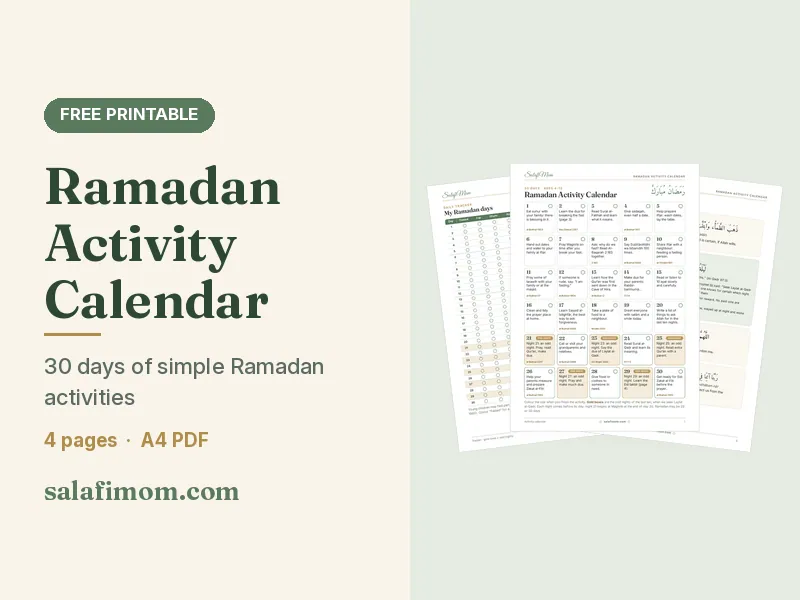
- Ramadan Activity Calendar: thirty simple activities, one for each day of the month, with no special supplies needed. It sits nicely next to the deeds chart.
Frequently asked questions
What should be on a Ramadan good deeds chart for kids?
Small daily deeds a child can really do: saying Bismillah, smiling, helping at iftar, giving sadaqah, reading Qur’an, making dua for parents. Each deed on our list comes from the Qur’an, the Sunnah or simple good manners.
Should I reward my child for completing the chart?
Small encouragement is fine, but keep the focus on Allah’s reward. Praise the effort and the intention. Avoid large prizes, which make the deed about the gift.
My child keeps forgetting. What do I do?
Read the deed out loud at suhur or breakfast, and stick the chart where you eat. Forgetting is normal. “The most beloved deed to Allah is the most regular and constant even if it were little” (al-Bukhari 6464), so aim for steady, not perfect.
Is a good deeds chart an innovation?
No. A chart is just a reminder tool, like a shopping list. The deeds themselves are what matter, and they should all be established ones. What we avoid is attaching invented rituals or special celebrations to it.
Can toddlers use a good deeds chart?
Yes, with one deed repeated all week and lots of help. See our Ramadan activities for toddlers for more ideas for the youngest ones.
Keep going
For a full month of ideas, see our pillar guide to Ramadan activities for kids. If your children are older and like to write, our Ramadan journal for kids turns each day’s deed into a short reflection.
May Allah make our children love doing good for His sake, in Ramadan and after it. Ameen.