· Umm Aishah · 7 min read
Free Ramadan Worksheets for Kids (PDF): Word Search, Maze, Dua Tracing
The Ramadan worksheets we actually use at home, by age: a word search, a masjid maze, iftar dua tracing, a true-or-false Sunnah quiz with sources, and more. Faceless, music-free and free to print.
Good Ramadan worksheets do two jobs at once: they keep children busy during the long afternoons, and they quietly teach what Ramadan really is. The set we use at home has six kinds of sheet: a Ramadan word search, a maze to the masjid, iftar dua tracing, a true-or-false Sunnah quiz, Arabic word matching, and a daily reflection page. Every one is faceless, music-free and built on authentic sources.
Below I share exactly what goes on each sheet (word lists, quiz questions with their hadith, and age tips) so you can print ours or make your own in ten minutes. Our ready-made free PDFs are linked at the end, and for activities away from the table, see our main guide to Ramadan activities for kids.
Ramadan 2027 is expected to begin around 8 February 2027, subject to the sighting of the moon. Printing a stack of worksheets in January means one less thing to think about when the month arrives.
What makes a good Ramadan worksheet?
When I search for “Ramadan worksheets for kids PDF”, most of what comes up is cute but empty: smiling crescent moons with faces, lanterns to colour, and a “countdown to Eid”. My daughters enjoy those for five minutes and learn nothing about fasting. So I set three rules for ours:
- Teach something true. Every sheet should carry a real piece of knowledge: a dua, a sunnah of fasting, an Arabic word, an ayah.
- Keep it faceless. No people, animals or smiling objects. We use masjids, dates, letters and geometric patterns.
- Match the child. A four-year-old needs a fat-line maze; a ten-year-old needs a quiz that makes them think.
1. Ramadan word search
A word search is the easiest win for ages 6 to 10. Our list builds vocabulary they will hear all month:
| Easier grid (ages 6–7) | Harder grid (ages 8–10) |
|---|---|
| FAST | SUHUR |
| DATES | IFTAR |
| DUA | TARAWEEH |
| QURAN | SADAQAH |
| SALAH | ZAKAT AL FITR |
| MASJID | LAYLAT AL QADR |
| WATER | PATIENCE |
| SHARE | MAGHRIB |
Make it count: after the puzzle, ask your child to pick three words and say one sentence about each. “Suhur is the meal before Fajr. The Prophet (ﷺ) said there is blessing in it.” That is the real lesson.
2. Maze to the masjid
For ages 3 to 6. The child draws a line from a house to a masjid, collecting a prayer mat and a Qur’an on the way. For younger ones, make the paths wide and the turns few. For older ones, add dead ends and a rule: “You must pass the water tap for wudu first.”
Talk while they work: Which prayer do we go to the masjid for in the evening in Ramadan? What do we say when we enter? (Allāhummaftaḥ lī abwāba raḥmatik, “O Allah, open for me the doors of Your mercy” (Muslim 713).)
3. Iftar dua tracing
This is the sheet I would print first. Children trace the authentic iftar dua in Arabic, with transliteration and meaning underneath:
ذَهَبَ الظَّمَأُ، وَابْتَلَّتِ الْعُرُوقُ، وَثَبَتَ الْأَجْرُ إِنْ شَاءَ اللَّهُ
Dhahaba adh-dhama’u, wabtallatil-‘urūqu, wa thabatal-ajru in shā’ Allāh. “The thirst has gone, the veins are moistened, and the reward is certain, if Allah wills.” (Abu Dawud 2357, graded hasan by al-Albani)
- Ages 4–5: trace only بِسْمِ اللَّهِ in big outline letters, the word they say before the first date.
- Ages 6–8: trace the first line of the iftar dua, then the whole dua over the following weeks.
- Ages 9+: copy it out without tracing, then explain it in their own words.
Many printables online use a different iftar dua, “Allahumma laka sumtu…”. Its narration is weak, so we leave it off our sheets. Our guide to the dua for breaking the fast for kids explains the difference and how to teach the authentic one.
4. True or false: the Sunnah of fasting
My older daughters love this one because they get to “catch” the false statements. Each true statement has its source so you can check together.
- Eating suhur has a blessing in it. True. “Take suhur, as there is a blessing in it” (al-Bukhari 1923).
- We should wait a long time after sunset before eating. False. “The people will remain on the right path as long as they hasten the breaking of the fast” (al-Bukhari 1957).
- The Prophet (ﷺ) broke his fast with dates, or water if there were none. True. (Abu Dawud 2356, graded hasan sahih by al-Albani)
- If someone is rude to a fasting person, he should shout back. False. He should say “I am fasting” (al-Bukhari 1904).
- The Qur’an was sent down in Ramadan. True. Allah says: شَهْرُ رَمَضَانَ ٱلَّذِىٓ أُنزِلَ فِيهِ ٱلْقُرْءَانُ, “The month of Ramadan in which was revealed the Qur’an” (al-Baqarah 2:185).
- Fasting means only no food; bad words don’t matter. False. “Whoever does not give up forged speech and evil actions, Allah is not in need of his leaving his food and drink” (al-Bukhari 1903).
- Giving someone food for iftar earns a reward like their fast. True. (at-Tirmidhi 807, graded sahih by al-Albani)
- The Prophet (ﷺ) was more generous in Ramadan than at any other time. True. (al-Bukhari 1902)
For ages 7 and up, read the statements aloud and let younger siblings shout “true” or “false”. For ages 10 and up, ask them to write the reason next to each answer.
5. Arabic word matching
A simple matching sheet: Arabic word on the left, English on the right, draw a line between them. Choose words they will hear every day of the month:
- صَوْم: fasting
- سُحُور: suhur (pre-dawn meal)
- إِفْطَار: breaking the fast
- تَمْر: dates
- مَاء: water
- قُرْآن: Qur’an
- صَدَقَة: charity
- دُعَاء: supplication
For early readers, add the letter they should circle in each word. If your child is just starting Arabic, keep the list to four words a week.
6. Daily reflection page
For ages 8 and up, a half-page with four short prompts:
- Today I fasted: none / part / all of the day
- One good deed I did:
- One thing I learned about Ramadan:
- A dua I made today:
If your child enjoys this sheet, it can grow into a full Ramadan journal. See our Ramadan journal for kids for a 30-day version.
Which worksheets for which age?
| Age | Best sheets | Time |
|---|---|---|
| 3–5 | Masjid maze, Bismillah tracing, colouring patterns | 5–10 min |
| 6–7 | Easy word search, first line of iftar dua, Arabic matching | 10–15 min |
| 8–10 | Hard word search, full dua tracing, true or false | 15–20 min |
| 11+ | True or false with reasons, reflection page | 20 min |
One or two sheets a day is plenty. Worksheets are a support, not the main event. The real Ramadan lessons happen at the suhur table, on the prayer mat and when your child hands a plate of dates to a neighbour.
How we use worksheets during a fasting day
- Late afternoon is worksheet time. It is the slowest part of the day for children who are practising fasting, and for us.
- Keep a folder. Each child gets a plain folder for the month. Seeing it fill up is motivating in itself.
- Talk more than you correct. If the dua tracing is wobbly, that is fine. Ask them what it means instead.
- Don’t let sheets replace Qur’an. Our rule: Qur’an first, worksheets after.
What we leave out of our worksheets
So that the sheets match the Sunnah, we do not include:
- Faces, animals or people, including smiling moons, stars or dates.
- Lanterns and crescent decorations as Ramadan symbols.
- Countdown calendars to Eid. Each day of Ramadan is worship in itself, not a box to tick on the way to Eid.
- Weak duas and invented “Ramadan facts”. Every dua and statement on our sheets has a reference you can check.
Get the free printables
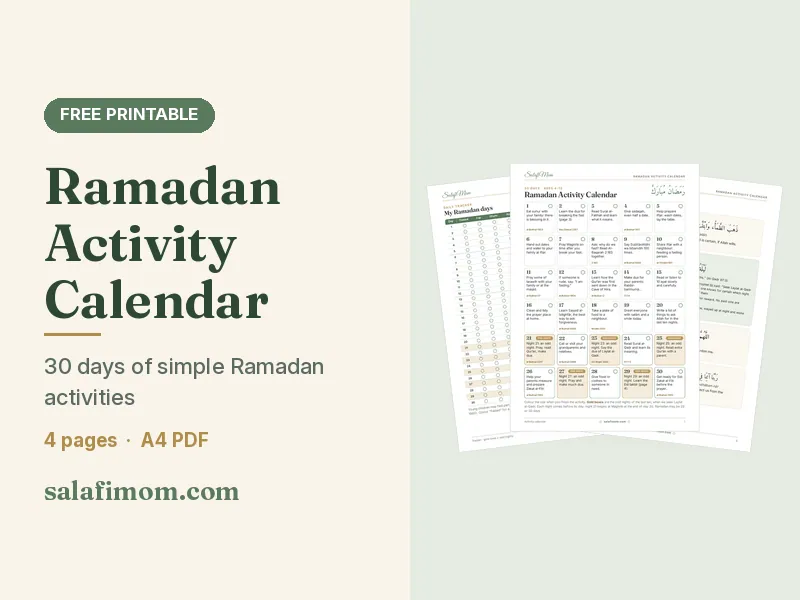
- Ramadan Activity Calendar: thirty simple activities, one for each day of the month, with nothing that needs special supplies. A good companion to the worksheets.
- Daily Duas Flashcards: referenced, fully voweled dua cards, including the iftar dua.
- Ramadan 2027 Family Pack: we are putting our full worksheet set into one printable pack. Join the waitlist and we will email you when it is ready.
Frequently asked questions
Where can I find free Ramadan worksheets for kids as a PDF?
Our free Ramadan Activity Calendar and Daily Duas Flashcards are ready to print now, and this post gives you the full content for a word search, maze, dua tracing sheet, Sunnah quiz and Arabic matching sheet you can make at home.
What age are Ramadan worksheets for?
From about age 3 (mazes and tracing) up to 12 (quizzes and reflection pages). See the age table above.
Are your Ramadan worksheets free of images of living beings?
Yes. We use masjids, dates, letters and geometric patterns only. No faces, animals or people.
How many worksheets should my child do each day in Ramadan?
One or two is enough. Keep the focus on fasting practice, prayer, Qur’an and helping the family.
May Allah make this Ramadan one our children remember for what they learned and loved, not only for what they coloured. Ameen.