· Umm Aishah · 7 min read
What Age Should You Start Teaching Your Child Qur'an? (A Stage-by-Stage Answer)
There is no age too young to start hearing the Qur'an. Here is what to teach at each stage, from babies to ten-year-olds, with examples from the Companions' children.
“What age should I start teaching my child Qur’an?” is the question I am asked most by new mothers. My honest answer is: you have already started. Every time your baby hears you recite, the Qur’an is going in.
Formal lessons, though, come in stages. In short: from birth, let them listen. From about two to four, teach short surahs by ear. From about four or five, start learning the letters to read. By seven, when they are commanded to pray, aim for al-Fatihah and several short surahs. From seven to ten, build steady memorisation and reading from the mushaf. Every child is different, so read these as rough guides, not deadlines.
Here is what each stage looks like in our home, and what the Sunnah tells us about how young the Companions’ children were.
How young were the Companions’ children?
Three narrations in Sahih al-Bukhari give us a real picture.
Ibn ‘Abbas, by age ten. He said: “Allah’s Messenger (ﷺ) died when I was a boy of ten years, and I had learnt the Muhkam” (al-Bukhari 5035). He explained that the Muhkam meant the Mufassal (al-Bukhari 5036), the shorter surahs at the end of the Qur’an. So by ten, he had all of those by heart.
‘Amr ibn Salamah, at six or seven. As a boy, he memorised the Qur’an he heard from passing travellers. When his people looked for the one who knew the most Qur’an among them, “they found none who knew more Qur’an than I… and at that time I was a boy of six or seven years” (al-Bukhari 4302).
Mahmud ibn ar-Rabi’, at five. He said: “I remember the Prophet (ﷺ) took water from a bucket with his mouth and threw it on my face, and I was five years old” (al-Bukhari 77). Imam al-Bukhari placed this under the chapter “When is the hearing of a young child valid?” A five-year-old can remember and carry knowledge.
The lesson: young children are capable of far more than we expect, if the Qur’an is part of their everyday life.
The parent’s duty starts early
Allah says:
يَٰٓأَيُّهَا ٱلَّذِينَ ءَامَنُوا۟ قُوٓا۟ أَنفُسَكُمْ وَأَهْلِيكُمْ نَارًۭا
“O you who have believed, protect yourselves and your families from a Fire…” (at-Tahrim 66:6)
Teaching our children the Qur’an is one of the best ways we protect them. And the Prophet (ﷺ) said: “The best among you are those who learn the Qur’an and teach it” (al-Bukhari 5027). When the student is your own child, you are doing both at once.
Stage by stage: what to teach and when
Birth to 2: listening
- Recite around them. While feeding, rocking, folding laundry. Your voice reciting is the best “programme” there is.
- Play recitation, not noise. A reliable reciter, with no music or sound effects. Keep it calm, not on all day as background.
- Say the adhkar out loud. Bismillah before feeding, the three Quls at bedtime. They will be saying them with you before you know it.
At this age there is no “lesson”. There is only an atmosphere.
Ages 2 to 4: short surahs by ear
- Start with al-Fatihah and al-Ikhlas. Then al-Falaq and an-Nas.
- Echo, don’t drill. You say a short phrase, they repeat. Two or three minutes, several times a day.
- Attach practice to routines. The same short slot each day, for example after breakfast. The three Quls fit naturally at bedtime, since reciting them before sleep is from the Sunnah (al-Bukhari 5017).
- Expect wobbly pronunciation. That’s normal. Model it correctly and gently, and don’t stop them to correct every sound.
Most two- and three-year-olds can learn several short surahs this way. Our step-by-step plan for this age is in Quran memorization for beginners.
Ages 4 to 6: letters and the first reading steps
- Learn the Arabic letters. By sound and shape, a few a week. Our free Arabic Alphabet Chart goes on the wall where they play.
- Move to a beginner reading primer (such as a Qa’idah) when they know the letters, around four to six depending on the child. Ten minutes a day is plenty.
- Keep memorising by ear. Reading and memorising are separate skills. A child can memorise far beyond what they can read. Follow our Juz Amma memorisation order and add surahs steadily.
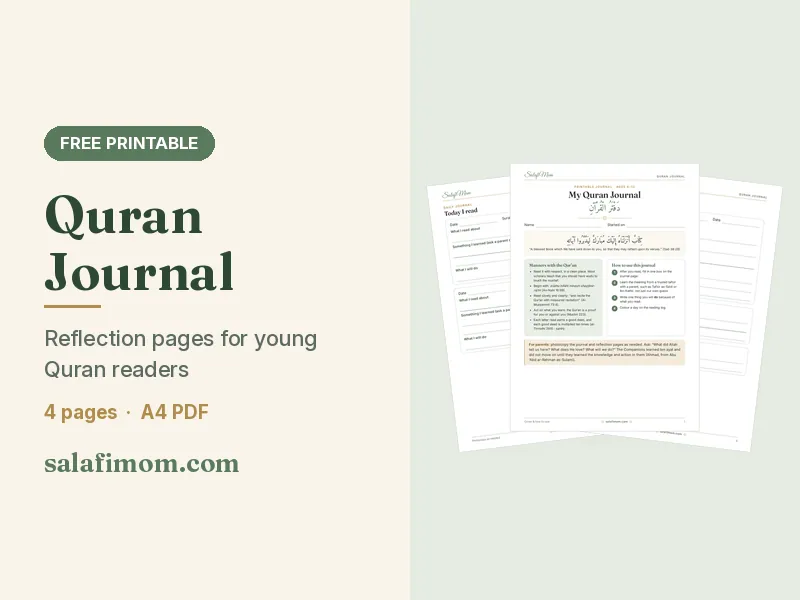
- Start a simple log. A tick for each surah learned. Our free Quran Memorization Log is made for this.
Age 7: prayer, and Qur’an with it
The Prophet (ﷺ) said:
مُرُوا أَوْلاَدَكُمْ بِالصَّلاَةِ وَهُمْ أَبْنَاءُ سَبْعِ سِنِينَ
“Command your children to pray when they become seven years old.” (Abu Dawud 495, graded hasan sahih by al-Albani)
A child who is praying needs al-Fatihah, and some short surahs to recite after it. So by seven, aim for al-Fatihah perfectly, and at least the last ten surahs of the Qur’an. Many children will have much more.
Ages 7 to 10: steady hifz and reading from the mushaf
- A fixed daily slot. Twenty to thirty minutes: new lesson, then revision.
- Read from the mushaf. Reading fluency usually catches up with memorisation in these years.
- Revision becomes the main job. Our Qur’an revision schedule for kids shows how we split it.
- Find a teacher who recites correctly to hear new lessons and correct mistakes, even if most work happens at home.
- Aim for Juz’ ‘Amma by around ten, like Ibn ‘Abbas, if Allah makes it easy. Some will go further.
Ages 10 and up
From here it depends on the child and the family. Some begin full hifz with a teacher; others carry on steadily at home alongside other studies. Either way, keep revision daily and keep the meaning alive.
Signs your child is ready for formal lessons
Age matters less than these:
- They can sit for five to ten minutes with you.
- They can repeat a short phrase after you.
- They are curious about the mushaf or about what you are reciting.
- They don’t melt down when gently corrected.
If they are not there yet, keep listening and reciting together. Readiness comes.
Is it ever too late?
No. If your child is eight, ten or twelve and has not started, start today with al-Fatihah and the last few surahs. Older children often move much faster, because they understand what they are doing and why. And remember: the one who struggles with the Qur’an has a double reward (al-Bukhari 4937).
Mistakes I made (so you don’t have to)
- Starting reading too early. With my first, I pushed letters at three. She cried, I got frustrated. With my second I waited until five, and she flew.
- Measuring by other children. Cousins and classmates will always seem ahead. They aren’t racing your child.
- Forgetting revision. We memorised ten surahs fast, then lost four. Revision from day one.
- Making it a chore. Qur’an time should feel safe and warm, never a punishment.
Frequently asked questions
At what age should a child start memorising Qur’an?
Most children can start memorising short surahs by ear from around two to three, beginning with al-Fatihah and al-Ikhlas. Formal daily lessons usually start around four to five.
When should a child start reading the Qur’an?
Usually after they know the Arabic letters, often between four and six. Ten minutes a day with a beginner primer, then moving to the mushaf, is a gentle pace.
What should my child know by age seven?
Al-Fatihah perfectly, plus several short surahs to recite in prayer. The Prophet (ﷺ) commanded children to be taught to pray at seven (Abu Dawud 495).
Can a toddler learn Qur’an?
Yes, by listening and repeating. Keep it short, joyful and tied to daily routines, and don’t expect perfect pronunciation.
My child is 10 and hasn’t started. Is it too late?
Not at all. Start with al-Fatihah and the shortest surahs. Older children often progress quickly once they begin.
May Allah make the Qur’an the first thing our children love and the last thing they forget. Ameen.