· Umm Aishah · 8 min read
Juz Amma for Kids: The Best Memorisation Order + Free Tracker
The order we use to memorise Juz' 'Amma with our children, from al-Fatihah and an-Nas up to an-Naba', in six stages with revision built in and a free tracker.
When my eldest finished her first surah, she wanted to know which one came next. I opened the mushaf, flicked to the end, and realised I had no real plan. Should she go in mushaf order from an-Naba’? Shortest first? Whatever her cousin was doing?
After three children, this is the order we use: al-Fatihah first, then the last surah of the Qur’an (an-Nas), working backwards towards an-Naba’ (surah 78). We go in six stages, each one a little harder than the last, and we revise everything already learned before adding anything new.
Juz’ ‘Amma, the 30th part of the Qur’an, has 37 surahs and 564 ayat. Most of it is short, rhythmic and full of pictures a child can hold in their mind: the elephant army, the night, the dawn, the mountains like carded wool. It is where nearly every child starts, and for good reason.
Why start with Juz’ ‘Amma at all?
Because the Companions’ children started there too. ‘Abdullah ibn ‘Abbas (may Allah be pleased with him) said:
تُوُفِّيَ رَسُولُ اللَّهِ صلى الله عليه وسلم وَأَنَا ابْنُ عَشْرِ سِنِينَ وَقَدْ قَرَأْتُ الْمُحْكَمَ
“Allah’s Messenger (ﷺ) died when I was a boy of ten years, and I had learnt the Muhkam.” (al-Bukhari 5035)
In the next narration he explains that by the Muhkam he meant the Mufassal (al-Bukhari 5036): the shorter surahs at the end of the Qur’an, which include all of Juz’ ‘Amma. So a ten-year-old Companion had the short surahs by heart. That is a beautiful, realistic goal for our own children.
And the reward is not only for the quick ones. The Prophet (ﷺ) said that the one who recites the Qur’an and is skilled in it is with the noble, righteous scribes, “and the one who recites the Qur’an, keeps at it, and finds it difficult, will have a double reward” (al-Bukhari 4937). Tell your slower child that one often.
Step zero: al-Fatihah comes first
Before any surah of Juz’ ‘Amma, teach al-Fatihah. It is recited in every rak’ah, and the Prophet (ﷺ) said:
لاَ صَلاَةَ لِمَنْ لَمْ يَقْرَأْ بِفَاتِحَةِ الْكِتَابِ
“There is no prayer for the one who does not recite the Opening of the Book.” (al-Bukhari 756)
A child who will be commanded to pray at seven needs al-Fatihah well before then. In our house it was learned at bedtime, a line a night, until it was solid.
The Juz’ ‘Amma memorisation order, in six stages
We go backwards from an-Nas (114) to an-Naba’ (78). The surahs get longer as you go, so difficulty rises gently, and by the time your child reaches an-Naba’ they have years of practice behind them. It also means that when they later read from the mushaf, everything they know sits together at the back.
Here is the full order with ayah counts, grouped into stages. Move to the next stage only when the current one is clean.
Stage 1: the first seven (ages 3 and up)
| # | Surah | Ayat |
|---|---|---|
| 114 | an-Nas | 6 |
| 113 | al-Falaq | 5 |
| 112 | al-Ikhlas | 4 |
| 111 | al-Masad | 5 |
| 110 | an-Nasr | 3 |
| 109 | al-Kafirun | 6 |
| 108 | al-Kawthar | 3 |
The three Quls (al-Ikhlas, al-Falaq, an-Nas) are recited every morning, evening and bedtime, so your child hears them daily and they go in fast. Some families teach al-Ikhlas before an-Nas because it is shorter; either is fine.
Stage 2: short and story-rich (ages 4 and up)
| # | Surah | Ayat |
|---|---|---|
| 107 | al-Ma’un | 7 |
| 106 | Quraysh | 4 |
| 105 | al-Fil | 5 |
| 104 | al-Humazah | 9 |
| 103 | al-‘Asr | 3 |
| 102 | at-Takathur | 8 |
| 101 | al-Qari’ah | 11 |
Al-Fil and Quraysh are a lovely pair: one is the story of the elephant army, the next is about the safety Allah gave Quraysh afterwards. Tell the story in your own words first and the ayat make sense.
Stage 3: longer lines (ages 5 and up)
| # | Surah | Ayat |
|---|---|---|
| 100 | al-‘Adiyat | 11 |
| 99 | az-Zalzalah | 8 |
| 98 | al-Bayyinah | 8 |
| 97 | al-Qadr | 5 |
| 96 | al-‘Alaq | 19 |
| 95 | at-Tin | 8 |
| 94 | ash-Sharh | 8 |
A note on al-Bayyinah: only eight ayat, but the ayat are long. If your child stalls, it is perfectly fine to do al-Qadr first and come back to it. The order serves the child, not the other way round.
Stage 4: the “night and day” surahs (ages 6 and up)
| # | Surah | Ayat |
|---|---|---|
| 93 | ad-Duha | 11 |
| 92 | al-Layl | 21 |
| 91 | ash-Shams | 15 |
| 90 | al-Balad | 20 |
| 89 | al-Fajr | 30 |
Stage 5: building stamina (ages 7 and up)
| # | Surah | Ayat |
|---|---|---|
| 88 | al-Ghashiyah | 26 |
| 87 | al-A’la | 19 |
| 86 | at-Tariq | 17 |
| 85 | al-Buruj | 22 |
| 84 | al-Inshiqaq | 25 |
| 83 | al-Mutaffifin | 36 |
| 82 | al-Infitar | 19 |
Stage 6: the long four (ages 8 and up)
| # | Surah | Ayat |
|---|---|---|
| 81 | at-Takwir | 29 |
| 80 | ’Abasa | 42 |
| 79 | an-Nazi’at | 46 |
| 78 | an-Naba’ | 40 |
The ages are only rough guides from our own home. A keen five-year-old may be in Stage 4; a nine-year-old who started late may be in Stage 2. Both are doing well if they are moving forward and keeping what they have.
How much to memorise each day
Our rule is only as much as they can recite cleanly tomorrow. Roughly:
- Ages 3 to 4: one short ayah, or half a long one, learned by ear over a few days.
- Ages 5 to 6: one to three ayat a day.
- Ages 7 to 9: three to five ayat, or a few lines.
- Ages 10 and up: half a page to a page, if they are steady.
The Prophet (ﷺ) said “the most beloved deed to Allah is the most regular and constant even if it were little” (al-Bukhari 6464). Ten minutes every day will take a child further than an hour on Saturdays.
The daily method we use
- Listen. The child listens to the new ayat several times, from you or from a reliable reciter (recitation only, nothing with music or background sounds).
- Repeat line by line. You say a line, they echo it. Correct gently, one or two mistakes at a time.
- Link it. Once the new ayat are steady, they recite them joined to the ayat before. Most children forget at the joins, not in the middle.
- Recite it to someone. A parent, older sibling or teacher listens. A tick in the log.
- Revise. Yesterday’s lesson, then a few older surahs. No new lesson until yesterday’s is clean.
The full beginner’s method, with how we set up the space and time, is in our guide to Quran memorization for beginners. For planning the revision side properly, see our Qur’an revision schedule for kids.
Keep revision in the plan from day one
The Prophet (ﷺ) said:
تَعَاهَدُوا الْقُرْآنَ فَوَالَّذِي نَفْسِي بِيَدِهِ لَهُوَ أَشَدُّ تَفَصِّيًا مِنَ الإِبِلِ فِي عُقُلِهَا
“Commit yourself to the Qur’an, for by Him in whose Hand is my soul, it is surely more prone to break away than a camel in its bind.” (al-Bukhari 5033)
Going backwards through Juz’ ‘Amma makes revision simple: each week, your child recites from wherever they have reached back down to an-Nas. When that gets too long (usually around Stage 4), split the stages across the days of the week.
Track it on paper
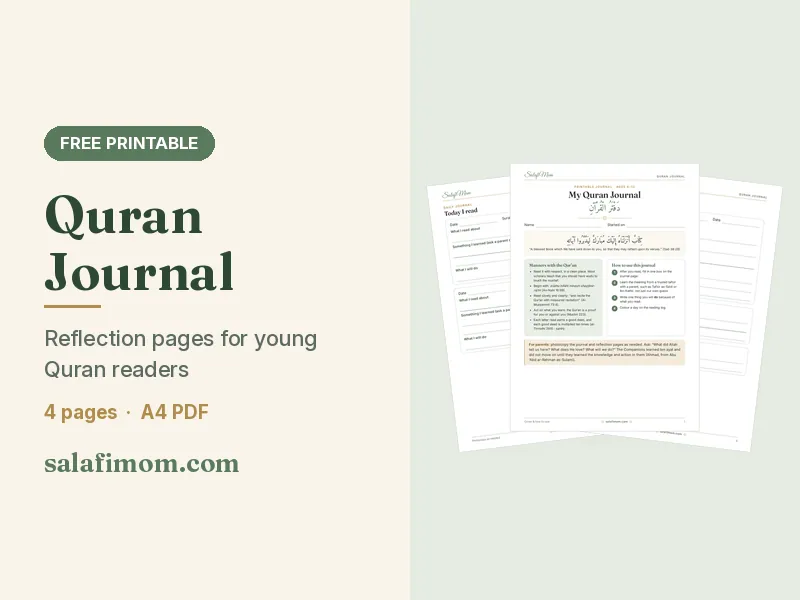
Children love to see a list fill up. Our free Quran Memorization Log has a line for each surah with a revision column and a parent check, so you can write the 37 surahs in this order and tick them off as you go. If your child is old enough to write a line about what they learned, pair it with the free Quran Journal. How we use the two together is in our post on the Quran memorization journal for kids.
When a surah is finished, write the date beside it. Years later, those dates are precious.
When it gets hard
- They keep mixing two surahs. Common with al-Falaq and an-Nas, or al-Layl and ash-Shams. Revise the pair together and point out where they differ.
- They are bored. Go back to the meaning. Tell the story behind the surah, or explain one word a day.
- They can’t read yet. That’s fine. Juz’ ‘Amma is learned by ear for years before reading catches up. If you’re unsure when to begin, see what age to start teaching Qur’an.
- You can’t recite well yourself. Learn alongside them, and find a teacher who reads correctly to check both of you.
Frequently asked questions
What is the best order to memorise Juz Amma for kids?
Start with al-Fatihah, then go backwards from an-Nas (114) to an-Naba’ (78). The surahs get longer as you go, so difficulty rises gently. Small swaps, like al-Qadr before al-Bayyinah, are fine.
How long does it take a child to memorise Juz Amma?
It depends on age and consistency. A child doing a few ayat most days, with revision, often finishes in one to three years. Ibn ‘Abbas had memorised the short surahs by the age of ten (al-Bukhari 5035).
Should my child memorise Juz Amma in mushaf order instead?
You can, but an-Naba’, an-Nazi’at and ‘Abasa are among the longest surahs in the juz’, so it is a hard start for little ones. Backwards order lets them win early.
Is there a Juz Amma tracker PDF?
Yes. Our free Quran Memorization Log works as a Juz’ ‘Amma tracker: write the surahs in the order above and tick each one off with its revision.
My child forgets surahs they learned last year. What should I do?
Pause new memorisation for a week or two and revise from an-Nas upwards until everything is clean again. Then add a fixed weekly revision slot.
May Allah make our children among the people of the Qur’an, and make it a light for them in this life and the next. Ameen.