· Umm Aishah · 5 min read
Quran Memorization Journal for Kids: How to Use One (Free Printable)
A Qur'an journal turns memorisation into a habit a child can see. Here is how we use ours for hifz, revision and reflection, with free printable pages.
My eldest daughter used to forget which ayah she had reached. She would start the surah from the beginning every day, get frustrated, and stop. What changed things for us was not a new app or a new teacher. It was a simple notebook: a Qur’an journal.
The Prophet (ﷺ) said: “The best among you are those who learn the Qur’an and teach it” (al-Bukhari 5027). A journal does not replace a teacher who corrects recitation, but it gives a child something they can see: how far they have come, what needs revising, and what the ayat mean.
What a Qur’an memorisation journal is
It is a page (or a notebook) where your child records four things each day:
- The new lesson (sabaq): the surah and ayat they are memorising today.
- Revision (murajaʿah): what they revised, and how well.
- Meaning and reflection: one word or one meaning they learned, and one thing they will do.
- A parent or teacher check: a tick, a short note, or a date.
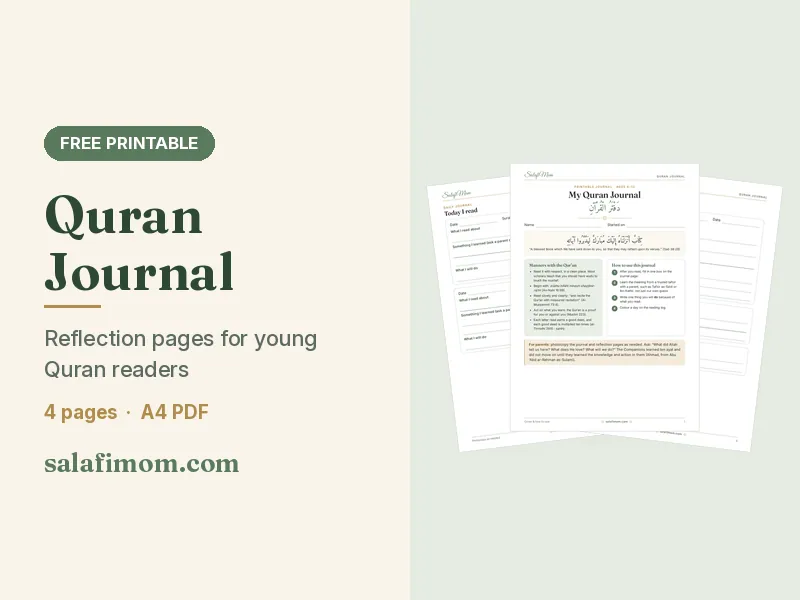
Our free Quran Memorization Log handles parts 1, 2 and 4: it tracks hifz surah by surah with a parent review column. Our free Quran Journal handles part 3: reflection pages for young readers. Many families use both.
Why revision has to be in the journal
The Prophet (ﷺ) said: “Commit yourself to the Qur’an, for by Him in whose Hand is my soul, it is surely more prone to break away than a camel in its bind” (al-Bukhari 5033).
Children lose what they do not revise. A journal makes revision visible: if the revision column has been empty for three days, you both know. In our home the rule is simple: no new lesson until yesterday’s lesson is clean.
How to use the journal, step by step
1. Choose a small daily amount. For a 5-year-old, that may be one or two short ayat from Juz’ ʿAmma. For a 10-year-old, perhaps three to five lines. Small and daily beats large and occasional: “the most beloved deed to Allah is the most regular and constant even if it were little” (al-Bukhari 6464).
2. Listen first, then read. The child listens to a reliable reciter or to you, then reads from the mushaf, then recites from memory. Record the surah and ayah numbers in the log.
3. Recite to someone. A parent, an older sibling or a teacher listens and ticks the parent-check box. Correct mistakes gently, and only one or two at a time.
4. Revise on a cycle. Yesterday’s lesson every day; the last week’s lessons every few days; older surahs once a week. Write each revision in the log with a simple rating: ✓ (clean), ~ (a few mistakes), ✗ (needs work).
5. Reflect on one ayah. In the Quran Journal, the child writes one word they learned and what the ayah teaches. Allah describes the Qur’an as “a blessed Book which We have revealed to you that they might reflect upon its verses” (Sad 38:29).
كِتَٰبٌ أَنزَلۡنَٰهُ إِلَيۡكَ مُبَٰرَكٞ لِّيَدَّبَّرُوٓاْ ءَايَٰتِهِۦ وَلِيَتَذَكَّرَ أُوْلُواْ ٱلۡأَلۡبَٰبِ
6. Review the week together. On one day each week, flip back through the journal. Point out how many ayat they have learned. Let them see the progress.
Encouragement for children who find it hard
Some children memorise quickly; others struggle. Tell the one who struggles about this hadith: “Such a person as recites the Qur’an and masters it by heart, will be with the noble righteous scribes. And such a person exerts himself to learn the Qur’an by heart, and recites it with great difficulty, will have a double reward” (al-Bukhari 4937).
And remind them that every letter counts: “Whoever recites a letter from Allah’s Book, then he receives the reward from it, and the reward of ten the like of it” (at-Tirmidhi 2910 · hasan sahih). Allah has made it easy: “And We have certainly made the Qur’an easy for remembrance, so is there any who will remember?” (al-Qamar 54:17).
وَلَقَدۡ يَسَّرۡنَا ٱلۡقُرۡءَانَ لِلذِّكۡرِ فَهَلۡ مِن مُّدَّكِرٖ
A sample journal page
| Date | New lesson | Revision | Rating | One word I learned | Checked by |
|---|---|---|---|---|---|
| Mon | an-Naba’ 1–5 | al-Ikhlas, al-Falaq | ✓ | yatasāʾalūn: they ask one another | Mum |
| Tue | an-Naba’ 6–10 | an-Naba’ 1–5 | ~ | mihādā: a resting place | Mum |
| Wed | (revise only) | an-Naba’ 1–10 | ✓ | Dad |
Tips from our homeschool
- Same time, same place. We do hifz straight after Fajr or after breakfast, before other lessons. See our Islamic morning routine for homeschool families.
- Keep stickers and pens simple. The page should be about the Qur’an, not decoration. Our printables use no pictures of people or animals.
- Do not compare siblings. Each child’s journal is their own.
- Celebrate finishing a surah with a little treat or a walk, and write the date at the top of the page so they remember it.
- In Ramadan, add a reflection line to each day. See our Ramadan activities for kids.
For the method behind our hifz routine, read our Quran memorization for beginners guide.
Frequently asked questions
At what age can a child start a Qur’an journal?
As soon as they are memorising anything at all. For a 4- or 5-year-old, you fill in the page while they colour the tick. From about 7, most children can write it themselves.
What is the difference between a Quran journal and a hifz log?
A hifz log records what was memorised and revised, and how well. A Qur’an journal records reflection: meanings, words learned and lessons. Our Quran Memorization Log is the first; our Quran Journal is the second.
How much should a child memorise each day?
Only as much as they can recite cleanly the next day. For young children that is often one to three short ayat. Consistency matters more than amount (al-Bukhari 6464).
Is a journal enough without a teacher?
No. Recitation should be checked by someone who reads correctly. The journal supports the teacher; it does not replace them.
Are the printables free?
Yes. Both the Quran Journal and the Quran Memorization Log are free PDFs for your family.
May Allah make the Qur’an the spring of our children’s hearts and make them among its people. Ameen.