· Umm Aishah · 7 min read
Islamic Homeschooling for Beginners: A Calm 8-Step Start (Salafi Mum's Guide)
New to Islamic homeschooling? A calm, step-by-step start: your intention, the law where you live, priorities, a day built around salah, simple methods and your first term.
I still remember the night before our first homeschool day. I had a shelf of books, a laminated timetable and a knot in my stomach. What if I was not qualified? What if my children fell behind? What if I simply could not do it?
If that is where you are now, take a breath. Starting Islamic homeschooling is far simpler than it looks. You begin with a sincere intention, check what the law requires where you live, decide on a few clear priorities (Qur’an, salah and good character first), build a simple day around the five prayers, and start small. Everything else grows from there. Here is the calm 8-step start I wish someone had given me.
Step 1: Begin with your intention and dua
Before books and timetables, there is the heart. Ask yourself why you are doing this. For most of us it comes back to one thing: we want our children to know Allah, love His Messenger (ﷺ), and grow up upon the Sunnah.
This is a real responsibility. The Prophet (ﷺ) said:
كُلُّكُمْ رَاعٍ، وَكُلُّكُمْ مَسْئُولٌ عَنْ رَعِيَّتِهِ
“All of you are guardians and responsible for your wards…” (al-Bukhari 893)
And it is a great opportunity. The Prophet (ﷺ) said:
إِذَا مَاتَ الإِنْسَانُ انْقَطَعَ عَنْهُ عَمَلُهُ إِلاَّ مِنْ ثَلاَثَةٍ إِلاَّ مِنْ صَدَقَةٍ جَارِيَةٍ أَوْ عِلْمٍ يُنْتَفَعُ بِهِ أَوْ وَلَدٍ صَالِحٍ يَدْعُو لَهُ
“When a man dies, his deeds come to an end except for three: ongoing charity, beneficial knowledge, or a righteous child who prays for him.” (Muslim 1631)
Write your intention down and keep it somewhere you will see it on hard days. Then make dua, and keep making it. Homeschooling is done with Allah’s help, not our own cleverness.
Step 2: Check the law where you live
Homeschooling rules differ a lot from country to country, and even between regions. Some places only ask you to inform the local authority; others require registration, a curriculum or yearly assessments; a few do not allow it at all. Before you withdraw a child from school or skip enrolment, check the official education department website for your country or state, and keep records of what you do. This protects your family and your homeschool.
Step 3: Decide your priorities (and write them down)
You cannot do everything, especially in year one. So decide what comes first. In our home, the order is:
- Tawheed and love of Allah
- Salah
- Qur’an
- Adab and character
- Reading, writing and maths
- Arabic
- Everything else (science, history, nature, life skills)
When a day goes wrong, I go down this list from the top. If we prayed on time, recited Qur’an and were kind to each other, it was not a wasted day.
Step 4: Build your day around the five prayers
You do not need a timetable with half-hour slots. You need anchors. Allah tells us that prayer is “decreed upon the believers a decree of specified times” (an-Nisa 4:103), so the prayers already give your day its shape:
- Fajr to Dhuhr: adhkar, Qur’an, then core lessons while minds are fresh.
- Dhuhr to Asr: lunch, rest, lighter and independent work.
- Asr to Maghrib: outdoors, chores and family.
- After Maghrib: stories, family time, bed.
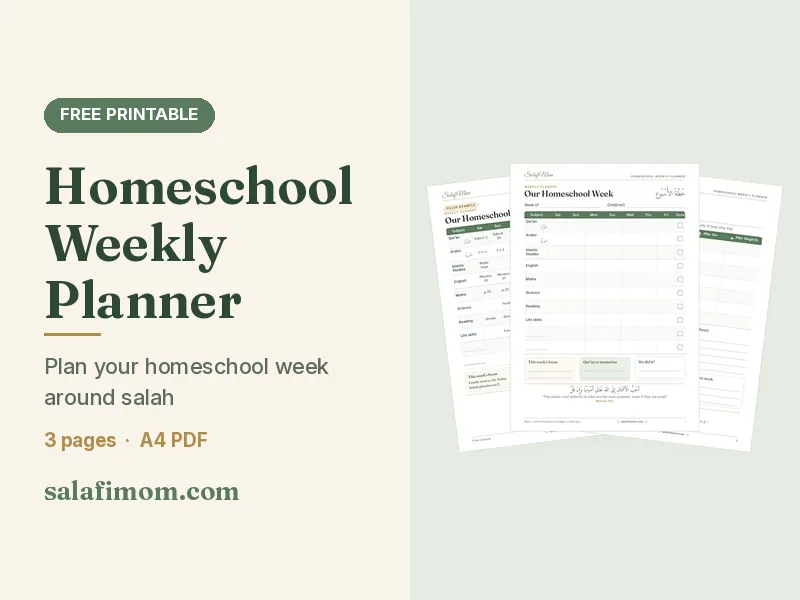
For three full sample days (winter, summer and a “minimum day”), see our Muslim homeschool schedule built around the five prayers.
Step 5: Teach to the age in front of you
What you teach and how long you teach it depends enormously on age. As a rough guide:
- Ages 2 to 4: 10 to 20 minutes of focused learning a day, the rest is play, duas at the right moments and listening to Qur’an. See Islamic preschool at home.
- Ages 5 to 7: about 1.5 to 2 hours a day in short blocks, with salah becoming a daily practice by seven. See Islamic homeschool for 5 to 7 year olds.
- Ages 8 to 12: 3 to 4 hours, with growing independence and deeper Islamic study. See homeschooling Muslim pre-teens.
Step 6: Keep methods simple and materials clean
Beginners often spend a fortune on curricula before they know how their children learn. Instead:
- Start with methods, not brands. Short daily lessons, reading aloud, real objects for maths, memorisation with revision, and lots of conversation.
- Choose materials free of images of living beings where you can: text-based books, letter cards, nature items, your own hand-made resources.
- Use what you have. A library card, a mushaf, paper and pencils will carry you a long way.
- Be careful with screens. They are easy to lean on and hard to step back from.
Our Islamic homeschool curriculum guide explains how to put the subjects together once you are ready.
Step 7: Start small, then build
In the first two to four weeks, do only three things every day: prayers, Qur’an and reading aloud. Add maths in week two. Add Arabic in week three. Add the rest once the rhythm is steady.
If your child is coming out of school, expect a settling period. Children need time to adjust to learning at home, and so do mothers.
The Prophet (ﷺ) said:
يَسِّرُوا وَلاَ تُعَسِّرُوا، وَبَشِّرُوا وَلاَ تُنَفِّرُوا
“Make things easy and do not make them hard, give good tidings and do not make people run away.” (al-Bukhari 69)
That applies to our children too. A slow, happy start beats an ambitious one that ends in tears.
Step 8: Plan your first term, then review
Once you have a rhythm, plan one term (about 10 to 12 weeks), not a whole year:
- What surahs will each child memorise?
- Which duas and short hadith?
- What will you cover in reading and maths?
- One Islamic studies topic per month (for example: the pillars of Islam, wudu and salah, stories of the Prophets).
Write it down subject by subject on one page. The Islamic Homeschool Starter Kit gives you the printables to get going in your first week.
At the end of each week, ask three questions: What went well? What was hard? What one thing will we change? Then keep going.
Beginner mistakes to avoid
- Copying school at home. You do not need six hours or a bell. Short and focused wins.
- Buying everything at once. Start with the basics and add as you learn your children.
- Comparing with other families. Every home, every child and every season is different.
- Neglecting yourself. Keep your own prayers, Qur’an and rest. Children learn more from what they see in you than from any lesson.
- Giving up after a bad week. Every homeschooling mother has had one. Small and steady is still the Sunnah way: “the most beloved deed to Allah is the most regular and constant, even if it were little” (al-Bukhari 6464).
Frequently asked questions
How do I start Islamic homeschooling?
Set your intention, check your local homeschooling law, decide your priorities (tawheed, salah, Qur’an, adab, then academics), build a daily rhythm around the five prayers, start with just a few subjects, and plan one term at a time.
Do I need to be a scholar or a qualified teacher to homeschool Islamically?
No. You need to teach what you know correctly, learn alongside your children, and refer to reliable sources and people of knowledge for what you do not know. For Qur’an recitation and tajweed, a qualified teacher is a great help as your children grow.
How many hours a day is Islamic homeschooling?
It depends on age: around 10 to 20 minutes for preschoolers, 1.5 to 2 hours for 5 to 7 year olds, and 3 to 4 hours for 8 to 12 year olds.
What do I need to buy to start?
Very little: a mushaf, a library card, paper, pencils, a few plain workbooks and some printables. Our Islamic Homeschool Starter Kit is free.
Is it too late to start homeschooling my older child?
No. Many families start at 9, 10 or later. Begin with the same small steps, give your child some say in the plan, and expect a settling-in period.
You can do this
The first day will not be perfect. Neither will the hundredth. But a mother who prays with her children, sits with them over the Qur’an and teaches them good manners every day is giving them something no school timetable can. Start small, stay consistent, and ask Allah for help.
May Allah make it easy for you, accept your efforts, and make your children the coolness of your eyes. Ameen.