· Umm Aishah · 7 min read
Islamic Homeschool for 5-7 Year Olds: What to Teach and a Realistic Week
What to teach a 5, 6 or 7 year old at home in Qur'an, salah, Arabic, Islamic studies, reading and maths, with a realistic weekly plan built around the prayers.

Five to seven is the age when homeschool starts to feel like “real school”. Your child can sit for a little longer, is starting to read, and is old enough to be taught salah properly. It is also the age when many mums panic and over-plan.
Here is the short answer. An Islamic homeschool for a 5 to 7 year old needs about two hours of focused learning a day, split into short blocks: Qur’an and salah first, then reading, writing and maths, then Arabic and Islamic studies a few times a week. Everything else is play, outdoors, chores and good conversation. Below is what to teach in each subject, and the realistic week we actually use.
Why 5 to 7 is a turning point
The Prophet (ﷺ) said:
مُرُوا أَوْلاَدَكُمْ بِالصَّلاَةِ وَهُمْ أَبْنَاءُ سَبْعِ سِنِينَ
“Command your children to pray when they become seven years old…” (Abu Dawud 495, graded hasan sahih by al-Albani)
So by the end of this stage, your child should know how to make wudu and pray, and be praying regularly. That gives the years from five to seven a clear goal. Everything you teach in Islamic studies at this age can point towards it.
It is also the age where habits set. Whatever your child does every day at six, they will likely still be doing at ten. So choose a few good things and make them daily.
What to teach a 5 to 7 year old
Qur’an
- Memorisation: work through the short surahs of Juz ‘Amma, from an-Nas backwards. Aim for steady progress rather than speed: a few lines a week with solid revision is excellent.
- Reading: begin learning to read the Arabic script of the mushaf, letter joins and short vowels first.
- Meaning: one simple sentence of meaning for each surah you memorise. “Al-Ikhlas tells us Allah is One and nobody is like Him.”
The method we use is in Qur’an memorisation for beginners.
Salah and wudu
- Age 5: learn the steps of wudu and copy the movements of salah.
- Age 6: learn what to say in each position: takbir, al-Fatihah, the words of ruku’ and sujud, the tashahhud bit by bit.
- Age 7: pray the five prayers, with you reminding them kindly every time.
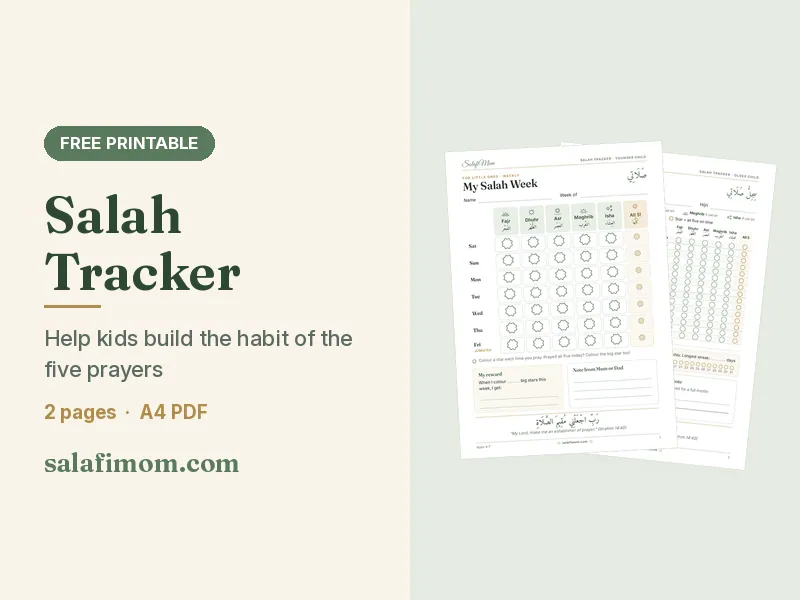
A simple salah tracker on the wall helps a six-year-old see their own progress without you nagging.
Aqeedah and Islamic studies
Short, clear lessons, two or three times a week:
- Who is your Lord? What is your religion? Who is your Prophet? These three questions, with simple answers, are the backbone.
- The pillars of Islam and the pillars of iman, one at a time.
- Stories of the Prophets, told by you from authentic sources, without dramatised or invented details.
- Short hadith on manners, memorised one per fortnight.
Arabic
At this age, build vocabulary and reading. Name things around the house in Arabic, practise letter forms, and read simple words. Our guide to teaching Arabic at home has gentle ways to start even if you are not fluent yourself.
Adab and character
Keep working on salam, honesty, kindness to siblings, respecting elders and helping at home. The Prophet (ﷺ) corrected children gently and in the moment, which is the best model for this age.
Reading, writing and maths
These are part of an Islamic homeschool too. Seeking beneficial knowledge is good, and reading opens the door to everything else. At this age:
- Reading: phonics in your home language, reading aloud together daily.
- Writing: letter formation, copying short sentences, then writing their own.
- Maths: counting, adding and subtracting with real objects (dates, buttons, coins), simple measuring in the kitchen, telling the time by the prayer clock.
- Science and nature: observation outdoors. Seeds, weather, the moon’s phases. Every lesson ends with “Who made this?”
A note on materials. I deliberately do not recommend specific workbooks here. Many mainstream early-years books are full of cartoon animals and characters. Choose plain phonics and maths resources, nature study outdoors rather than picture books, and your own hand-made cards. The method (short daily practice, real objects, reading aloud) matters far more than which brand you buy.
How long should homeschool take for a 5 to 7 year old?
Roughly:
- Age 5: 60 to 90 minutes of focused learning a day.
- Age 6: about 1.5 to 2 hours.
- Age 7: about 2 to 2.5 hours.
Break it into 15 to 25 minute blocks. Imam al-Bukhari named a chapter in his Book of Knowledge: “The Prophet (ﷺ) used to take care of the people in preaching by selecting a suitable time so that they might not become averse.” Under it he placed the hadith:
يَسِّرُوا وَلاَ تُعَسِّرُوا، وَبَشِّرُوا وَلاَ تُنَفِّرُوا
“Make things easy and do not make them hard, give good tidings and do not make people run away.” (al-Bukhari 69)
If your six-year-old is in tears over a worksheet, stop. A child who loves learning will learn more in the long run than one who has been pushed past their limit.
A realistic week for a 5 to 7 year old
This is our actual week, adjusted to winter prayer times. Not every day goes to plan, and that is fine.
| Sun / Mon / Wed | Tue / Thu | Fri / Sat | |
|---|---|---|---|
| After Fajr | Morning adhkar, breakfast | Same | Same, slower |
| Block 1 | Qur’an: new lines + revision (20 min) | Qur’an (20 min) | Qur’an revision only |
| Block 2 | Reading + phonics (25 min) | Reading (25 min) | Read-aloud together |
| Snack + outdoors | |||
| Block 3 | Maths with objects (20 min) | Maths (20 min) | Baking or measuring |
| Before Dhuhr | Arabic (15 min) | Aqeedah / Islamic studies (15 min) | Family visit or outing |
| After Dhuhr | Lunch, quiet reading, rest | Same | Free |
| After Asr | Outdoors, nature, chores | Handwork, chores | Free |
| After Maghrib | Story of a Prophet, duas | Same | Same |
Adjust the weekend to your country. Our free Homeschool Weekly Planner has this layout ready to fill in. For a full hour-by-hour day for this age, see our sample Islamic homeschool schedule for a 6-year-old.
Tips from our home
- Qur’an first. Do it while minds are fresh, before anything else crowds it out.
- Keep the table time short. Move between sitting and moving: a reading block, then a run in the garden.
- Let them teach you. Ask your child to “teach” a younger sibling the dua they learned. Nothing fixes knowledge like teaching it.
- Reward consistency, not perfection. A sticker for every day of Qur’an, not for every perfect recitation.
- Limit screens. Screens make the work of attention so much harder at this age.
- Make dua for them out loud. Let your child hear you ask Allah to make them righteous.
Frequently asked questions
What should a 5 year old learn in Islamic homeschool?
Short surahs, the basic duas, the steps of wudu, copying salah, Arabic letters and simple words, the answers to “Who is your Lord, what is your religion, who is your Prophet”, and early reading and counting through play.
What should a 6 year old know about Islam?
By six, many children know the five pillars of Islam, can recite several short surahs, know the daily duas, and are learning what to say in each position of salah. Every child is different, so go at your child’s pace.
Is two hours a day enough for a 7 year old?
Yes. Two focused hours a day, with reading aloud and real-life learning around it, is plenty at seven. Children at school spend much of the day waiting and transitioning.
What is the best Islamic curriculum for 5 to 7 year olds?
The one you will actually use every day. Build it subject by subject, starting with Qur’an and salah.
My 5 year old cannot read yet. Is that a problem?
No. Many children read between five and seven. Keep reading aloud daily, keep phonics short and playful, and the reading will come. If you have concerns about speech, hearing or eyesight, speak to your doctor.
Where to go next
If your child is younger, start with our Islamic preschool at home guide for ages 2 to 4. When they grow past seven, our guide to homeschooling Muslim pre-teens (8 to 12) shows how to build independence and deeper study.
May Allah make it easy for you and bless your children with beneficial knowledge. Ameen.