· Umm Aishah · Homeschool · 2 min read
Teaching Arabic at Home: A Gentle Start for Young Children
Arabic is the language of the Quran and the language of Jannah. Here is how to introduce it to your children in a way that feels natural and joyful.
The Prophet (ﷺ) said: “Love the Arabs for three reasons: I am an Arab, the Quran is in Arabic, and the language of the people of Paradise is Arabic.” (Authenticated by Al-Albani)
Teaching Arabic to our children is not just a cultural choice — it is a spiritual investment. When a child understands the words of their Lord directly, they experience the Quran in a way no translation can replicate.
Start with the letters
For children aged 3–5, begin with the Arabic alphabet. Do not rush. Spend a week on each letter if needed.
- Use multisensory methods: Tracing letters in sand, forming them with playdough, or writing them with water on a chalkboard makes learning stick.
- Introduce the letter sounds, not just names. Alif says a, Ba says b, Ta says t. This builds phonemic awareness early.
- Pair each letter with a simple word. Alif is for asad (lion), Ba is for baqarah (cow), Ta is for tuffah (apple).
Make it visual and repetitive
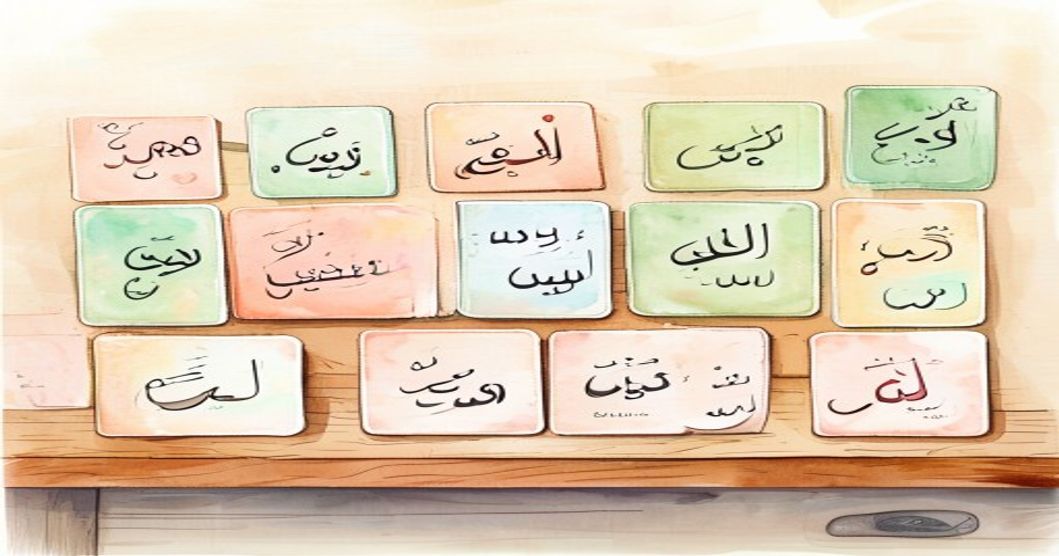
Children learn through repetition and association. Stick flashcards on the wall at their eye level. Point to them throughout the day: What letter is this? Can you make its sound?
We use:
- Arabic Alphabet Flashcards (Free Printable) — 28 beautiful cards for each letter
- Arabic Alphabet Chart (Free Printable) — a colorful wall chart for your classroom
- Arabic Handwriting Practice (Free Printable) — tracing sheets for fine motor skills
- Arabic Alphabet Mastery Pack (Premium) — complete learning bundle with activities
Incorporate Arabic into daily routines
Even if you are not fluent yourself, you can introduce basic vocabulary:
- Assalamu alaikum (peace be upon you) — when entering a room
- Bismillah (in the name of Allah) — before eating, drinking, or starting any task
- Alhamdulillah (all praise is for Allah) — after finishing
- Subhanallah (glory be to Allah) — when seeing something beautiful
These phrases become muscle memory when repeated daily.
Be patient with yourself
You do not need to be fluent to teach your child Arabic. Start with what you know, and learn alongside them. Many of us are relearning the language as adults — and that is perfectly fine.
The scholars say that learning Arabic is a communal obligation (fard kifayah). If no one in the community knows it, everyone is accountable. Your effort, even if imperfect, is pleasing to Allah.
May Allah make the Arabic language easy for our children and grant them understanding of His Book. Ameen.