· Umm Aishah · 8 min read
How to Teach Kids to Pray: From Age 3 Copying to Age 7 Commanding (Step by Step)
At what age should a child start praying, and how do you actually teach it? The Sunnah ruling, a gentle age-by-age plan, and simple salah steps for kids.
The Prophet (ﷺ) gave us the timeline himself: “Command your children to pray when they are seven years old, and discipline them for it when they are ten, and separate them in their beds.” (Abu Dawud 495, graded hasan sahih by al-Albani)
So a child is commanded to pray from seven, and held to it more firmly from ten. But the command at seven is not where teaching starts. It is where it becomes regular. By the time our children turn seven, we want them to already know wudu, the movements, and al-Fatihah, so that the command feels like the next small step, not a sudden new rule.
Here is how we teach salah to our children at home, from toddlers copying us on the prayer mat to a ten-year-old who prays all five on time, with the evidence for each step.
The ruling in brief
- Before puberty, prayer is not yet obligatory on the child. The Prophet (ﷺ) said: “The pen is lifted from three: the sleeper until he wakes, the child until he reaches puberty, and the insane until he comes to his senses.” (Abu Dawud 4403, graded sahih by al-Albani)
- But it is obligatory on us, the parents, to command them at seven. Shaykh Ibn ‘Uthaymin explained that the command in this hadith is an obligation on the guardian, because it is part of caring for the child, and that its purpose is to train them so that prayer is easy and beloved to them when they grow up.
- Allah commands us to keep at it with patience: وَأْمُرْ أَهْلَكَ بِالصَّلَاةِ وَاصْطَبِرْ عَلَيْهَا “And command your family to pray, and be patient upon it.” (Ta-Ha 20:132)
That last word, iṣṭabir, “be patient upon it,” is the whole of parenting in one verse. Teaching salah is not one conversation. It is years of gentle, steady reminders.
Why salah comes first
Before the method, give your child the why, in words they can hold:
- It is the first thing we will be asked about. The Prophet (ﷺ) said: “The first of his deeds that a servant will be brought to account for on the Day of Resurrection is his prayer. If it is sound, he has succeeded.” (at-Tirmidhi 413, graded sahih by al-Albani)
- It is a pillar of Islam. “Islam is built on five…” and prayer is the second (al-Bukhari 8).
- It is our conversation with Allah, five times a day.
For older children, add the seriousness: “Between a man and shirk and disbelief is abandoning the prayer.” (Muslim 82). Keep this for when they can understand it, not to frighten a little one.
Stage 1: Ages 2 to 4, copying and joining in
At this age, children learn salah the way they learn to talk: by being around it.
- Let them see you pray. Pray where they can watch, not always behind a closed door.
- Let them stand next to you. If they wander off halfway, that is fine. The Prophet (ﷺ) prayed while carrying his granddaughter Umamah. When he went into sujud he put her down, and when he stood he picked her up again (al-Bukhari 516).
- Give them their own little prayer mat. It makes them feel part of it.
- Teach the words they can say: Allahu akbar, Subhana Rabbiyal-A’la in sujud, Assalamu ‘alaykum wa rahmatullah at the end.
- Start al-Fatihah by ear. Recite it slowly at bedtime every night.
Do not: correct every movement or make them stay still. The goal at this stage is love, not precision.
Stage 2: Ages 5 to 6, learning the steps
This is when we start real teaching, a little each day.
- Wudu first. Salah needs wudu, so teach it as part of the routine. Our step-by-step guide to teaching wudu to children and the free Wudu Chart printable make it simple.
- Al-Fatihah by heart. The Prophet (ﷺ) said: “There is no prayer for the one who does not recite the Opening of the Book.” (al-Bukhari 756). Make this the main memorisation goal of the year.
- One short surah after it. al-Ikhlas is perfect.
- Practise one rak’ah together at a set time each day, Maghrib works well for us, then build up.
- Praise effort, not perfection. “I saw how still you were in sujud. Masha’ Allah.”
Stage 3: Age 7, the command begins
Now we begin to command our children to pray, every prayer, every day. Start this on or around the seventh birthday, kindly and clearly.
- Make it a milestone. Tell them: “The Prophet (ﷺ) told parents to ask their children to pray at seven. You are seven now, so you are a big Muslim who prays.”
- Pray as he prayed. The Prophet (ﷺ) said: “Pray as you have seen me praying.” (al-Bukhari 631). So teach the Sunnah way, not a made-up children’s version.
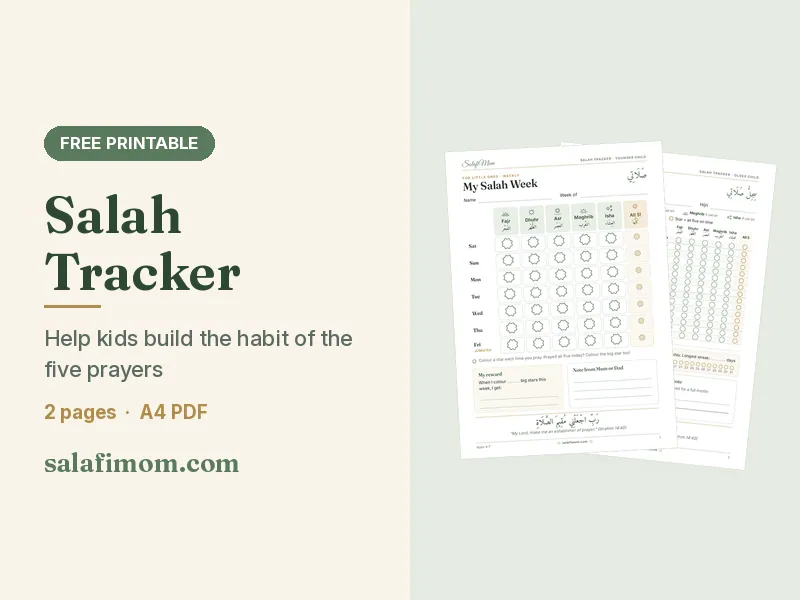
- Track it together. A simple chart helps children see their own progress. Our free Salah Tracker printable and the My Salah Journey printable are designed for exactly this age. See how we use a daily salah tracker.
- Boys to the masjid. When boys can behave, take them with you. Anas (may Allah be pleased with him), as a boy, prayed behind the Prophet (ﷺ) with an orphan beside him, and his mother behind them (al-Bukhari 727).
- Girls: practise covering. Allah does not accept the prayer of a woman who has reached puberty without a head covering (Abu Dawud 641, graded sahih by al-Albani). Give your daughter her own prayer garment early so it is a habit long before it is required.
Stage 4: Ages 8 to 10, consistency and quality
Between seven and ten, the aim is that all five prayers become automatic, on time, with correct movements and calm.
- Check the details. Is wudu complete? Is she rushing? Is he reciting al-Fatihah or mumbling? Correct gently and privately.
- Teach the meanings. What does Subhana Rabbiyal-‘Adhim mean? Why do we say Sami’allahu liman hamidah? Understanding brings khushu’.
- Make dua for them out loud. رَبِّ اجْعَلْنِي مُقِيمَ الصَّلَاةِ وَمِنْ ذُرِّيَّتِي “My Lord, make me one who establishes prayer, and from my descendants.” (Ibrahim 14:40). Let them hear you ask Allah for their salah.
At ten: firmness, with wisdom
The hadith says “discipline them for it when they are ten.” The scholars explain this carefully, and we should too:
- It comes only after three full years of teaching and commanding, from seven to ten.
- Shaykh Ibn ‘Uthaymin said it applies only where it will actually benefit the child, and that what is meant is a light, non-harmful smack that corrects and causes no harm. It is never to the face. The Prophet (ﷺ) said: “If one of you strikes, let him avoid the face.” (al-Bukhari 2559)
- It is never in anger, never in front of others, and never to humiliate.
In our home, firmness at ten usually looks like a serious, private talk, loss of a privilege, or sitting with them until the prayer is done. The aim is always that they grow up loving salah, not fearing us.
Simple salah steps for kids
Here are the basic steps of a two-rak’ah prayer to practise together (with wudu done and facing the qiblah):
- Intention in the heart. No need to say it aloud.
- Takbir: raise the hands and say Allahu akbar.
- Recite al-Fatihah, then a short surah.
- Ruku’: bow, hands on knees, back straight. Say Subhana Rabbiyal-‘Adhim (سُبْحَانَ رَبِّيَ الْعَظِيمِ).
- Rise: say Sami’allahu liman hamidah, Rabbana lakal-hamd (سَمِعَ اللَّهُ لِمَنْ حَمِدَهُ رَبَّنَا لَكَ الْحَمْدُ).
- Sujud: forehead and nose, both hands, both knees and the toes on the ground, the seven parts the Prophet (ﷺ) named (al-Bukhari 812). Say Subhana Rabbiyal-A’la (سُبْحَانَ رَبِّيَ الأَعْلَى). (These words are from Muslim 772.)
- Sit briefly, then a second sujud.
- Stand for the second rak’ah and repeat steps 3 to 7.
- Sit for the tashahhud: at-tahiyyatu lillahi was-salawatu wat-tayyibat… (al-Bukhari 831).
- Salam: turn to the right and to the left, saying Assalamu ‘alaykum wa rahmatullah.
Teach one step a week if you need to. A seven-year-old who knows these ten steps well is ready for every prayer.
Common struggles and what helped us
“I forgot.” Link each prayer to something that already happens: Dhuhr after lunch, Maghrib before dinner.
“I’m too tired.” Pray Isha earlier in the time on school nights, and keep the routine short and calm.
Rushing. Pray beside them sometimes, at a calm pace, so they feel the rhythm.
Siblings giggling. Separate them in the row for a while. Keep it light, not a battle.
Frequently asked questions
At what age should a child start praying in Islam? Children should be commanded to pray at seven (Abu Dawud 495). They can and should start learning and joining in well before that.
Is prayer obligatory on a seven-year-old? Not on the child yet; it becomes obligatory at puberty (Abu Dawud 4403). But it is obligatory on the parent to command the child from seven.
Does my child’s prayer count if they make mistakes? Allah rewards them for their effort, in sha’ Allah. Keep teaching gently and correct the important things, like wudu and al-Fatihah, first.
Should young children pray in the masjid? Yes, when they can stay calm and not disturb others. Start with one prayer a week.
May Allah make us and our children among those who establish the prayer. Ameen.