· Umm Aishah · 7 min read
How to Teach Arabic to Toddlers at Home (Even If You Don't Speak It)
A gentle, screen-free way to bring Arabic into your toddler's day: everyday words, letter sounds through play, a letter-of-the-week plan, and Qur'an by ear.
My youngest said mā’ (water) before she said “water”. Not because we are an Arabic-speaking home (we are not), but because every single time I filled her cup, I said “mā’?” and held it up. Toddlers don’t learn languages in lessons. They learn them in the kitchen, the bath and the car.
So here is the short answer to how to teach Arabic to toddlers at home: use a small set of Arabic words and phrases every day in real routines, let them meet the letters through play rather than worksheets, and fill their ears with the Qur’an. You do not need to be fluent. You need to be consistent, and you need about twenty words to start.
Below is exactly how we do it from about one to four years old, what we avoid, and a simple letter-of-the-week plan you can follow.
Why start Arabic so young?
Allah says:
إِنَّآ أَنزَلْنَٰهُ قُرْءَٰنًا عَرَبِيًّۭا لَّعَلَّكُمْ تَعْقِلُونَ
“Indeed, We have sent it down as an Arabic Qur’an that you might understand.” (Yusuf 12:2)
Arabic is the language of the Book our children will recite every day of their lives. The earlier its sounds are familiar, the easier the Qur’an is to read and, in sha Allah, to understand.
Toddlers are also at the best age for sounds. Letters like ع, ح, ق and خ that trouble adult learners come naturally to a two-year-old who hears them often. If you wait until eight, you are fighting habits; at two, you are building them.
Ages 1 to 2: words in routines
At this age, your only job is exposure with meaning. Pick a handful of words and use them every time the thing happens.
| Arabic | Say it | Meaning | When we use it |
|---|---|---|---|
| مَاءٌ | mā’ | water | every drink |
| حَلِيبٌ | ḥalīb | milk | milk time |
| خُبْزٌ | khubz | bread | breakfast |
| بَابٌ | bāb | door | going in and out |
| يَدٌ | yad | hand | washing hands |
| عَيْنٌ | ’ayn | eye | bath time, naming body parts |
| شَمْسٌ | shams | sun | going outside |
| قَمَرٌ | qamar | moon | evening walk |
| نَعَمْ / لَا | na’am / lā | yes / no | all day |
And the phrases of the Muslim day, which are Arabic too:
- Bismillāh before eating, drinking and getting dressed.
- Al-ḥamdu lillāh after food and when they sneeze.
- As-salāmu ‘alaykum when anyone comes in.
- Jazākallāhu khayrā to say thank you.
These are Arabic your child will use every day for the rest of their life.
Tip: say the Arabic word first, then the English if you need to. “Mā’? Water?” Over time, drop the English.
Ages 2 to 3: simple commands and the first letter sounds
Toddlers understand far more than they can say. Start giving small instructions in Arabic:
| Arabic | Say it | Meaning |
|---|---|---|
| تَعَالَ / تَعَالَيْ | ta’āla (boy) / ta’ālay (girl) | come here |
| اِجْلِسْ / اِجْلِسِي | ijlis / ijlisī | sit down |
| قُمْ / قُومِي | qum / qūmī | stand up |
| خُذْ / خُذِي | khudh / khudhī | take |
| أَعْطِنِي | a’ṭinī | give me |
Use them with a gesture until the gesture is not needed.
This is also when we bring in letters, by sound, through play:
- The scatter method. Foam and magnetic Arabic letters on the fridge, the bath tiles and in a basket. “Bring me the one that says bbb.” I explain exactly how we do this in the scatter method.
- Groove boards. Little fingers trace the shape of the letter in a wooden board while you say its sound. See wooden alphabet tracing boards.
- Sand and playdough. Draw ب in a tray of sand, roll a ل out of dough.
Sounds before names. “Bā’” is the name; b is the sound. A toddler who knows that ب says b is closer to reading than one who can recite the alphabet song.
Ages 3 to 4: letter of the week
Once your child enjoys the letters, give each one its own week. One letter a week takes 28 weeks, a little over half a year, and there is no rush.
Each week:
- Day 1: Show the letter. Say its sound. Find it on the Arabic Alphabet Chart on the wall.
- Day 2: Trace it with a finger in sand, on a groove board or on a flashcard.
- Day 3: Hunt for it around the house in the scatter letters.
- Day 4: Learn one word that starts with it (ب: بَابٌ bāb, door).
- Day 5: Older threes can trace it with a crayon on the Arabic Handwriting Practice sheet. Younger ones just colour it.
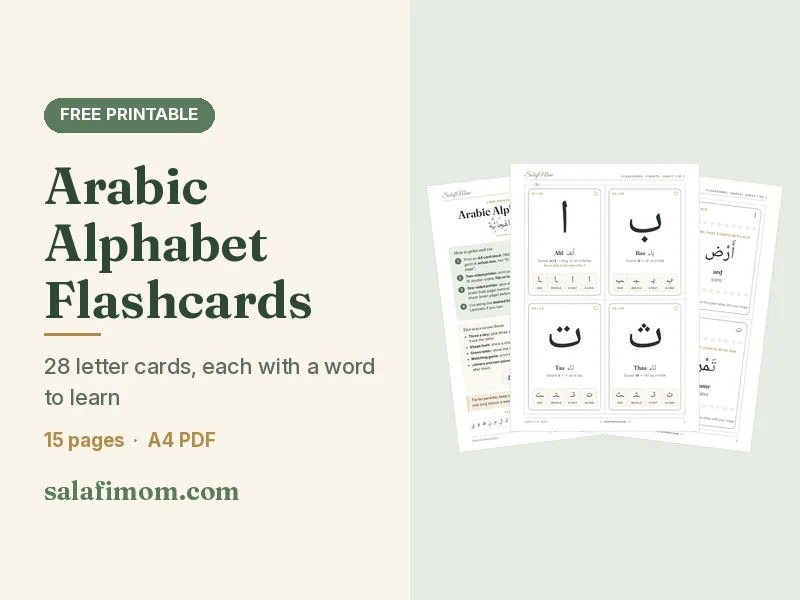
Use the Arabic Alphabet Flashcards to review all the letters learned so far, three or four at a time, once a day.
A suggested 28-week order
You can go in alphabet order, but we like to group letters that share a shape so children see that the dots make the difference:
- Weeks 1 to 4: ا ب ت ث
- Weeks 5 to 7: ج ح خ
- Weeks 8 to 11: د ذ ر ز
- Weeks 12 to 15: س ش ص ض
- Weeks 16 to 19: ط ظ ع غ
- Weeks 20 to 23: ف ق ك ل
- Weeks 24 to 28: م ن ه و ي
If a letter isn’t sticking, stay on it another week. Toddlers are not on a timetable.
Qur’an by ear runs alongside
Letter play is for reading later. Memorising starts now, by ear. Most toddlers can begin with al-Fatihah and al-Ikhlas, a phrase at a time, repeated after you. After those, we follow the Juz’ ‘Amma order: an-Nas, al-Falaq, then backwards through the short surahs.
What we avoid
- Screens and cartoon apps. Many “Arabic for kids” apps are animated characters, music and constant noise. A toddler learns language from a face and a voice, and you are the best one available.
- Songs with instruments. Lots of Arabic alphabet songs online come with music. We stay away from them and simply chant letter sounds together.
- Pictures of animals and people on the walls. We keep our walls to letters, objects and food.
- Pressure. If your toddler wanders off, the lesson is over. Try again tomorrow.
If you don’t speak Arabic yourself
This is most of us, so please don’t let it stop you.
- Learn the twenty words above yourself first. Stick them on the fridge.
- Learn the letter sounds properly from a teacher or a reliable reciter, so you pass on the right sounds for letters like ع and ح.
- Stay one step ahead. You only need to know this week’s letter and this week’s word.
- Learn together. Your child seeing you learn is a lesson in itself.
When your child is ready to go further, from around four or five, our guide to teaching Arabic at home covers the next steps.
A sample toddler day with Arabic in it
| Time | Arabic in the moment |
|---|---|
| Waking | The waking dua, then “as-salāmu ‘alaykum!” |
| Breakfast | Bismillāh, khubz, ḥalīb, al-ḥamdu lillāh |
| Play | Scatter letters: “bring me the one that says mmm” |
| Outside | shams, bāb, ta’āla! |
| Letter time (10 min) | This week’s letter: sound, trace, find |
| Bath | Body parts: yad, ‘ayn |
| Bedtime | The three Quls and the sleeping dua, in Arabic |
That is perhaps fifteen minutes of “teaching” in the whole day. The rest is just living with Arabic around them.
Frequently asked questions
What age can a toddler start learning Arabic?
From birth they can hear it. From around one, use Arabic words in daily routines. From around two to three, introduce letter sounds through play. Formal reading usually comes later, around four to six.
How can I teach my toddler Arabic if I don’t speak it?
Start with twenty everyday words and the Islamic phrases you already use, like Bismillāh and al-ḥamdu lillāh. Learn the letter sounds properly yourself, then teach one letter a week through play.
Should I teach Arabic letter names or sounds first?
Sounds first. A child who knows that ب says b is ready to start reading sooner.
Are Arabic apps good for toddlers?
We don’t use them. Most rely on cartoons and music, and toddlers learn language best from a real person talking with them.
Do you have free Arabic printables for toddlers?
Yes: the Arabic Alphabet Chart, Arabic Alphabet Flashcards and Arabic Handwriting Practice sheets are all free.
May Allah make the language of His Book beloved to our little ones and easy on their tongues. Ameen.